
Historic houses · North West England
Warrington Town Hall
In or near Stockton Heath.
Warrington Town Hall — a Grade I-listed historic house in england-west-midlands, United Kingdom.

Stephen McKay — CC BY-SA 2.0 via Wikimedia Commons licence

Plan your visit
- Typical visit
- 1 h–2 h
- Nearest railway station
- Warrington Bank Quay · 0.5 km
- Family-friendly
- Limited wheelchair access
Getting there & planning your visit
Warrington Town Hall is located at postcode WA1 1UH and is approximately 0.5 km from Warrington Bank Quay railway station. Entry is free, but wheelchair accessibility is limited.
About
Warrington Town Hall is a Grade I-listed building in england-west-midlands, United Kingdom. Grade I status is conferred by Historic England (or Cadw, Historic Environment Scotland or NIEA equivalents) on buildings of exceptional national interest. See the linked Wikipedia article for full historical and architectural details.
Photo gallery
From the Wikipedia article
Warrington Town Hall is in the town of Warrington, Cheshire, England. It consists of a house, originally called Bank Hall, flanked by two detached service wings at right angles to the house, one on each side. The house and the service wings are each recorded in the National Heritage List for England as designated Grade I listed buildings. Being in that part of the town north of the River Mersey, the house falls within the historic county of Lancashire. The architectural historian Nikolaus Pevsner declared it to be "the finest house of its date in south Lancashire".
Excerpt from Wikipedia under CC BY-SA 4.0. See the source article linked in Sources below.
Background
History
Bank Hall was built in 1750 for Thomas Patten. The architect was James Gibbs and it is likely that it was the last important building of his design to be completed in his lifetime. When it was built it stood in open countryside to the north of the town of Warrington. The Patten family were important merchants in the town. Thomas' father had made the lower River Mersey navigable from Runcorn to Bank Quay, Warrington, and had established a copper smelting factory at Bank Quay. In 1870 John Wilson-Patten, 1st Baron Winmarleigh, sold the hall to Warrington Borough Council for £9000 (equivalent to £|r=-4}}}} in ), and 13 acre of surrounding land for a further £15,000 (equivalent to £|r=-4}}}} in…
Architecture
The entrance hall is spacious and contains coats of arms of the Patten family, a stone chimney piece and a mosaic floor. The floor replaced a wooden one in 1902 and was laid by Italian workmen. It includes the initials J. W. P. for John Wilson Patten, L. W. for Lionel Whittle, was the town clerk at the time, T. L. for Thomas Longdin, the borough engineer, and Q. V. for Queen Victoria. The former great hall and the music room have been combined to form the council chamber. The former ladies retiring room and the dining room are now committee rooms and the reading room is used as the mayor's parlour. There are two similar staircases with wrought iron handrails. The window frames, which appear…
Sourced from Wikipedia under CC BY-SA 4.0.
- Coordinates
- 53.3897, -2.5997
- District
- Warrington
- Parish
- Warrington, unparished area
- Postcode
- WA1 1UH
- Parliamentary constituency
- Warrington South
- Established
- 1750
- Nearest railway station
- Warrington Bank Quay — 0.5 km
- Official site
- museum.westlancsfreemasons.org.uk
Sources
- wikidata: Q7970736 (CC0)
- wikipedia: Warrington Town Hall (CC BY-SA 4.0)
Other places nearby

Golden Gates
Natural landmarks · 0.1 km
Cameo Cinema
Theatres · 0.1 km

Old Public Baths Entrance
Public art & sculpture · 0.1 km

Warrington Museum Of Freemasonry
Museums · 0.2 km

Boer War Memorial
Memorials & monuments · 0.3 km

Memorial To South Lancashire Regiment In Queen's Gardens
Memorials & monuments · 0.3 km
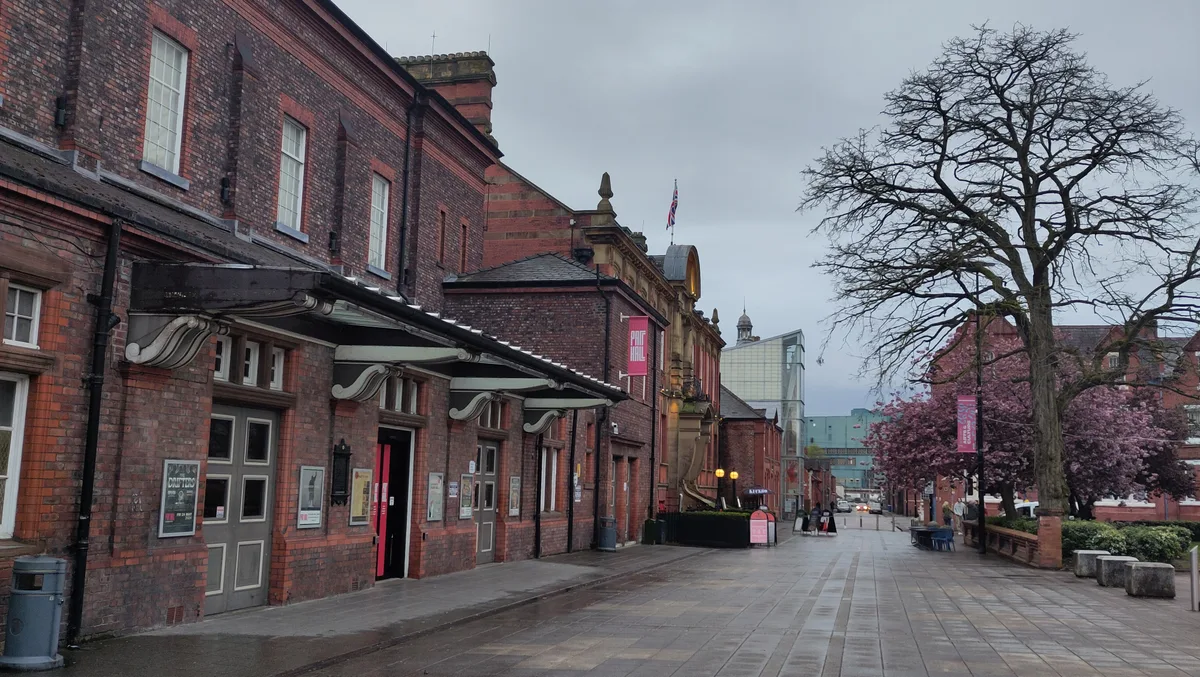
Parr Hall
Theatres · 0.3 km

Alice in Wonderland table
Public art & sculpture · 0.4 km
19–21 Sankey Street, Warrington
Historic houses · 0.4 km

Technically Brilliant
Galleries · 0.4 km

Warrington Museum & Art Gallery
Museums · 0.4 km
Warrington Museum & Art Gallery
Museums · 0.4 km
Nearby
📷 3Natural landmarks · North West England
Golden Gates
Golden Gates — a other in england-west-midlands, United Kingdom.
📷 3Theatres · North West England
Cameo Cinema
Cameo Cinema in England North West, United Kingdom.
📷 3Public art & sculpture · North West England
Old Public Baths Entrance
Old Public Baths Entrance — a public art in england-west-midlands, United Kingdom.
📷 3Museums · North West England
Warrington Museum Of Freemasonry
Warrington Museum Of Freemasonry — a museum in england-west-midlands, United Kingdom.
📷 3Memorials & monuments · North West England
Boer War Memorial
Boer War Memorial is a memorial in the United Kingdom.
📷 3Memorials & monuments · North West England
Memorial To South Lancashire Regiment In Queen's Gardens
Memorial To South Lancashire Regiment In Queen's Gardens — Grade II listed building-listed memorial in england-west-midlands, United Kingdom.
Where to eat & stay near Warrington Town Hall
Places to stay
 📷 5
📷 5 📷 5
📷 5Caravan parks · North West England
Meadow Bank Caravan Park
Meadow Bank Caravan Park — a caravan park in wales north.
 📷 5
📷 5 📷 5
📷 5Caravan parks · North West England
Canal Bank Farm caravan site
Canal Bank Farm caravan site — a caravan park in england west midlands.
 📷 5
📷 5Campsites · North West England
Holly Bank Caravan Park
Holly Bank Caravan Park — a campsite in england west midlands.
 📷 5
📷 5Caravan parks · North West England
Small Acre Caravan Park
Small Acre Caravan Park — a caravan park in wales north.
Places to eat & drink
 📷 5
📷 5Restaurants · North West England
Galleries Cafe
Galleries Cafe — a restaurant in wales north.
 📷 5
📷 5Historic pubs · North West England
The Wheatsheaf, St Helens
The Wheatsheaf, St Helens in Wales North, United Kingdom.
 📷 5
📷 5Historic pubs · North West England
The Norton Arms Public House
The Norton Arms Public House in Wales North, United Kingdom.
 📷 5
📷 5Historic pubs · North West England
Castle Hotel, Halton
Castle Hotel, Halton in Wales North, United Kingdom.
 📷 3
📷 3Historic pubs · North West England
Tricorn
Tricorn — Historic pub — listed building or notable heritage status.
 📷 5
📷 5Historic pubs · North West England
George and Dragon, Great Budworth
George and Dragon, Great Budworth in England North West, United Kingdom.
More historic houses in this region
 📷 3
📷 3Historic houses · North West England
116 Hospital Street, Nantwich
116 Hospital Street, Nantwich — substantial townhouse in Nantwich, Cheshire, England, UK.
 📷 3
📷 3Historic houses · North West England
140–142 Hospital Street, Nantwich
140–142 Hospital Street, Nantwich — grade II listed building in Nantwich, Cheshire East, Cheshire, England, UK.
 📷 3
📷 3Historic houses · North West England
46 High Street, Nantwich
46 High Street, Nantwich — house in Nantwich, Cheshire, England, UK.
 📷 3
📷 3Historic houses · North West England
64, St Ann's Road
64, St Ann's Road — Grade II* listed house in Middlewich, Cheshire East, England, UK.
Frequently asked questions
- Where is Warrington Town Hall?
- Warrington Town Hall is in North-West England, United Kingdom (postcode WA1 1UH), in the parish of Warrington, unparished area.
- What is Warrington Town Hall?
- Warrington Town Hall — a Grade I-listed historic house in england-west-midlands, United Kingdom.
- How do I get to Warrington Town Hall?
- The nearest railway station is Warrington Bank Quay, about 0.5 km away. The nearest town is Stockton Heath. Drivers can use postcode WA1 1UH.
- When was Warrington Town Hall built?
- Built or established in 1750.
- Who owns Warrington Town Hall?
- Warrington Town Hall is owned by | designation1 = Grade I.
- Is Warrington Town Hall a listed building?
- Warrington Town Hall is officially recognised as Grade I listed.
- How do I get to Warrington Town Hall?
- The nearest railway station is Warrington Bank Quay, about 0.5 km away. Drivers can navigate to postcode WA1 1UH.