
Memorials & monuments · London
Wellington Arch
Also known as: Áirse Wellington
In or near City of Westminster.
Wellington Arch — Monument, dating to 1846.

Wikimedia Commons contributors — see linked file page for photographer and licence licence

Plan your visit
- Typical visit
- 15 min–45 min
- Nearest railway station
- Hyde Park Corner · 0.2 km
- Free entry
- Family-friendly
- Dog-friendly
Getting there & planning your visit
Wellington Arch is located in Westminster, London, with the postcode SW1X 7HJ. The nearest railway station is Hyde Park Corner, which is 0.2 km away. Entry to the arch is free.
About
Wellington Arch is a public memorial or monument in the United Kingdom. Records date its origin to 1828. Designed by Decimus Burton. OpenStreetMap heritage rating: 2/5. Opening hours: Apr-Oct We-Su 10:00-17:00; Nov-Mar We-Su 10:00-16:00. Wikidata describes it as: "Monument, dating to 1846.". Coordinates: 51.5025°, -0.1508°.
Photo gallery
360° viewimagery from 2024
Imagery © Mapillary contributors, CC BY-SA 4.0
Heritage listing
The Wellington Arch, also known as the Constitution Arch or (originally) as the Green Park Arch, is a Grade I-listed triumphal arch by Decimus Burton that forms a centrepiece of Hyde Park Corner in central London, the road junction near the south-eastern corner of Hyde Park. The Arch stands on a large green-space traffic island with crossings for pedestrian access. The arch was built between 1826 and 1830 directly opposite Burton's Ionic Screen as part of a majestic approach route from Hyde Park to Buckingham Palace. In 1882–1883 it was taken down and rebuilt a short distance away, facing west, at its current site at the top of the Constitution Hill. As a result of a moratorium on expenditure from 1828, all the intended sculpture was omitted from the arch when it was built.
From the Historic England List Entry under OGL v3.
From the Wikipedia article
The Wellington Arch, also known as the Constitution Arch or (originally) as the Green Park Arch, is a Grade I-listed triumphal arch by Decimus Burton that forms a centrepiece of Hyde Park Corner in central London, the road junction near the south-eastern corner of Hyde Park. The Arch stands on a large green-space traffic island with crossings for pedestrian access. The arch was built between 1826 and 1830 directly opposite Burton's Ionic Screen as part of a majestic approach route from Hyde Park to Buckingham Palace. In 1882–1883 it was taken down and rebuilt a short distance away, facing west, at its current site at the top of the Constitution Hill. As a result of a moratorium on expenditure from 1828, all the intended sculpture was omitted from the arch when it was built. A public subscription was raised in 1837 for an equestrian statue of the 1st Duke of Wellington, to be placed on the arch. In 1846, over the vehement objections of Burton, a colossal equestrian statue by the sculptor Matthew Cotes Wyatt was installed on the arch, leading to the name by which the arch is known. When the arch was rebuilt in 1882-83, Matthew Cotes Wyatt's colossal statue was not reinstated. It was held in storage in London until 1885, when it was moved to Aldershot and re-erected. Since 1912 the sculpture Peace descending on the Quadriga of War by Adrian Jones, a bronze of the Goddess of Victory Nike riding a quadriga (an ancient four-horse chariot), has surmounted the arch.
Excerpt from Wikipedia under CC BY-SA 4.0. See the source article linked in Sources below.
Background
Architecture
at Hyde Park Corner. Apsley House can be seen through the arch.]] Even before the Battle of Waterloo had been fought, proposals were being made for a triumphal arch at Hyde Park Corner. One, by the architect William Kinnard, was remarkably similar to the final form which the Wellington Arch was to reach 100 years later (except that George III was atop the quadriga rather than Nike). Both the Wellington Arch and Marble Arch (originally sited in front of Buckingham Palace) were planned in 1825 by George IV to commemorate Britain's victories in the Napoleonic Wars. During the second half of the 1820s, the Commissioners of Woods and Forests and the King resolved that Hyde Park, and the area…
Visiting
The arch is hollow inside and until 1992 housed the smallest police station in London. Transferred to the ownership of English Heritage in 1999, it is open to the paying public: three floors of exhibits detailing the history of the arch, Exhibition space, and high terraces on both sides of the arch with views of the surrounding area. One half of the arch functions as a ventilation shaft for the Hyde Park Corner road underpass, constructed in 1961–1962.
Sourced from Wikipedia under CC BY-SA 4.0.
- Coordinates
- 51.5025, -0.1508
- District
- Westminster
- Parish
- Westminster, unparished area
- Postcode
- SW1X 7HJ
- Parliamentary constituency
- Cities of London and Westminster
- Established
- 1828
- Nearest railway station
- Hyde Park Corner — 0.2 km
- Opening
- Apr-Oct We-Su 10:00-17:00; Nov-Mar We-Su 10:00-16:00
Sources
- osm: w24923117 (ODbL)
- wikipedia: Wellington Arch (CC BY-SA 4.0)
- commons: Arco de Wellington, Hyde Park.jpg (CC BY-SA 4.0)
Other places nearby

Wellington Monument
Memorials & monuments · 0.1 km

Australia War Memorial
Memorials & monuments · 0.1 km

New Zealand War Memorial
Memorials & monuments · 0.1 km

Machine Gun Corps Memorial
Memorials & monuments · 0.1 km

Royal Artillery Memorial
Memorials & monuments · 0.1 km

Forecourt Railings, Piers And Gates To Apsley House
Piers · 0.1 km

Commonwealth Memorial Gates
Public art & sculpture · 0.1 km
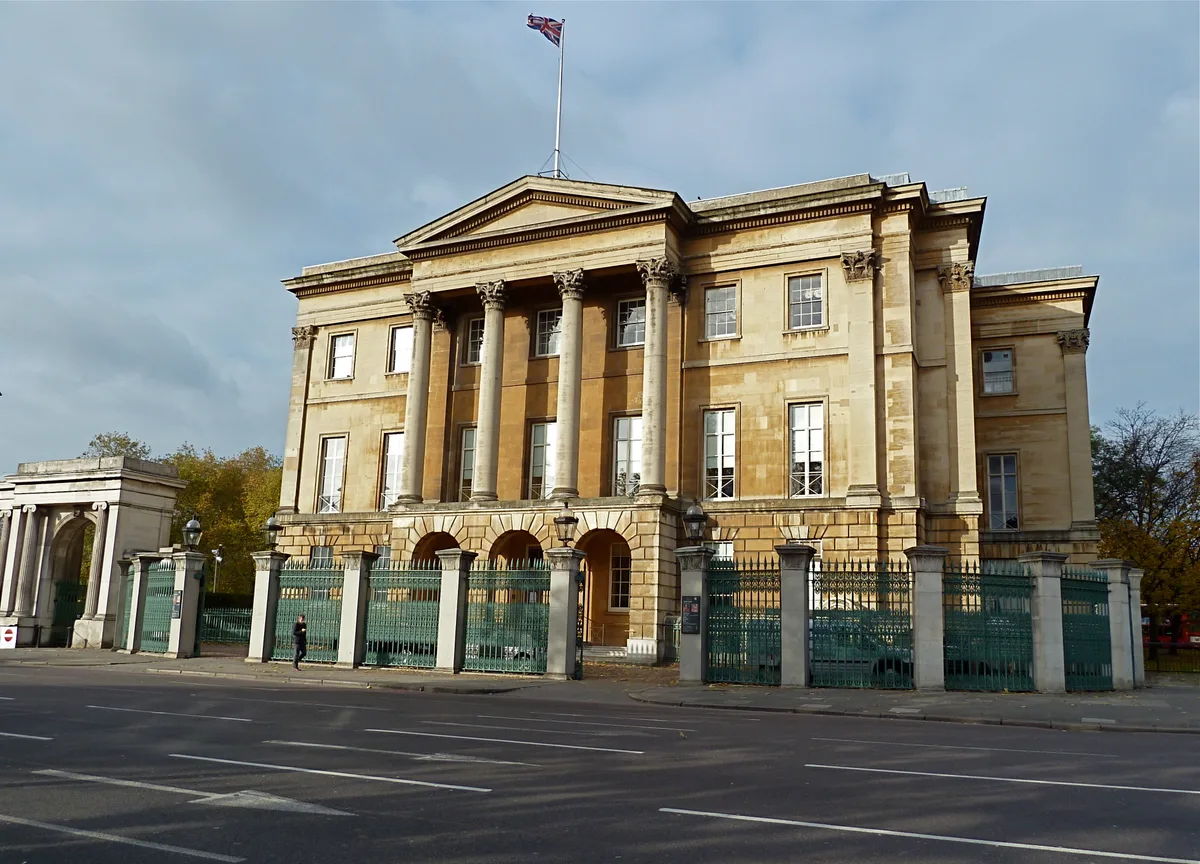
Apsley House
Galleries · 0.1 km

Napoleon as Mars the Peacemaker
Public art & sculpture · 0.1 km

The Lanesborough
Hotels · 0.1 km

Intercontinental London Park Lane
Hotels · 0.2 km

RAF Bomber Command Memorial
Memorials & monuments · 0.2 km
Nearby
📷 5Memorials & monuments · London
Wellington Monument
Wellington Monument is a memorial in the United Kingdom.
📷 5Memorials & monuments · London
Australia War Memorial
Australia War Memorial — a memorial in england-london, United Kingdom.
📷 5Memorials & monuments · London
New Zealand War Memorial
New Zealand War Memorial — a memorial in england-london, United Kingdom.
📷 5Memorials & monuments · London
Machine Gun Corps Memorial
Machine Gun Corps Memorial is a memorial in the United Kingdom.
📷 5Memorials & monuments · London
Royal Artillery Memorial
Royal Artillery Memorial — War memorial, dating to 1925.
📷 5Piers · London
Forecourt Railings, Piers And Gates To Apsley House
Forecourt Railings, Piers And Gates To Apsley House — a Grade I-listed pier in england-london, United Kingdom.
Where to eat & stay near Wellington Arch
Places to stay
📷 5📷 7Hotels · London
Intercontinental London Park Lane
Intercontinental London Park Lane — a hotel in england london. 5-star. Brand: InterContinental.
 📷 5
📷 5Hotels · London
Four Seasons Hotel, Park Lane
Four Seasons Hotel, Park Lane — a hotel in england london. 5-star. Brand: Four Seasons.
 📷 5
📷 5 📷 5
📷 5 📷 5
📷 5Hotels · London
The Athenaeum Hotel
The Athenaeum Hotel — a hotel in england london.
Places to eat & drink
 📷 5
📷 5Historic pubs · London
The Grenadier
The Grenadier in England London, United Kingdom.
 📷 5
📷 5Restaurants · London
Galvin at Windows
Galvin at Windows — a restaurant in england london. Cuisine: french;fine dining.
 📷 5
📷 5 📷 5
📷 5 📷 5
📷 5Restaurants · London
Alain Ducasse at The Dorchester
Alain Ducasse at The Dorchester — a restaurant in england london.
 📷 5
📷 5Other works by Decimus Burton
 📷 5
📷 5 📷 5
📷 5 📷 5
📷 5Gardens · London
Athenaeum Club
Athenaeum Club — a garden in england-london, United Kingdom.
 Flagship📷 5
Historic houses · London
Temperate House
Temperate House — a Grade I-listed historic house in england-london, United Kingdom.
Other memorials from this era
 📷 5
📷 5Memorials & monuments · London
Duke of York Column
Duke of York Column — Public artwork (statue).
.jpg?width=1200) 📷 5
📷 5Memorials & monuments · London
General Roy's Baseline (Northwest End) Cannon Monument
General Roy's Baseline (Northwest End) Cannon Monument is a memorial in the United Kingdom.
 📷 5
📷 5Memorials & monuments · London
George Grey's Obelisk
George Grey's Obelisk is a memorial in the United Kingdom.
 📷 5
📷 5More memorials in this region
.jpg?width=1200) 📷 5
📷 5Memorials & monuments · London
1st Surrey Rifles War Memorial
1st Surrey Rifles War Memorial is a memorial in the United Kingdom.
 📷 5
📷 5Memorials & monuments · London
24th East Surrey Division War Memorial
24th East Surrey Division War Memorial is a memorial in the United Kingdom.
 📷 5
📷 5Memorials & monuments · London
Abney Park Cemetery CWGC Cross
Abney Park Cemetery CWGC Cross is a memorial in the United Kingdom.
 📷 5
📷 5Memorials & monuments · London
Admiral Sir John Franklin
Admiral Sir John Franklin is a memorial in the United Kingdom.
Frequently asked questions
- Where is Wellington Arch?
- Wellington Arch is in London, United Kingdom (postcode SW1X 7HJ), in the parish of Westminster, unparished area.
- What is Wellington Arch?
- Wellington Arch — Monument, dating to 1846.
- How do I get to Wellington Arch?
- The nearest railway station is Hyde Park Corner, about 0.2 km away. The nearest town is City of Westminster. Drivers can use postcode SW1X 7HJ.
- When was Wellington Arch built?
- Built or established in 1828. Designed by Decimus Burton.
- Is Wellington Arch a listed building?
- Wellington Arch is officially recognised as Grade II listed building listed.
- Is Wellington Arch free to visit?
- Yes, Wellington Arch is free to enter.
- How do I get to Wellington Arch?
- The nearest railway station is Hyde Park Corner, about 0.2 km away. Drivers can navigate to postcode SW1X 7HJ.