
Memorials & monuments · London
Rabindranath Tagore
In or near Covent Garden.
Rabindranath Tagore — a memorial in england-london, United Kingdom.

PAUL FARMER — CC BY-SA 2.0 via Wikimedia Commons licence

Plan your visit
- Typical visit
- 15 min–45 min
- Nearest railway station
- Euston Square · 0.4 km
- Free entry
- Dog-friendly
- Wheelchair accessible
Getting there & planning your visit
To visit the Rabindranath Tagore memorial in Camden, London, you can reach it via Euston Square station, which is 0.4 km away. Entry is free, and the site is wheelchair accessible. The postcode for sat-nav is WC1E 6BT.
About
Rabindranath Tagore is a memorial located in england-london, United Kingdom. Sourced from OpenStreetMap (ODbL licence); see local listings for visitor information, opening hours and admission details.
Photo gallery
360° viewimagery from 2026
Imagery © Mapillary contributors, CC BY-SA 4.0
From the Wikipedia article
Rabindranath Thakur (Bengali: [roˈbindɾonatʰ ˈʈʰakuɾ]; anglicised as Rabindranath Tagore ; 7 May 1861 – 7 August 1941), also known by his pseudonym Bhanusimha (Sun Lion) was a Bengali polymath (poet, writer, playwright, composer, philosopher, social reformer, and painter) of the Bengal Renaissance period. In 1913, Tagore became the first Asian to win a Nobel Prize in any category, and also the first lyricist and non-European to win the Nobel Prize in Literature. A significant moulder of culture within the Indian subcontinent, he wrote and composed the national anthems of India and Bangladesh. He reshaped Bengali literature and music as well as Indian art with Contextual Modernism in the late 19th and early 20th centuries. He was the author of the "profoundly sensitive, fresh and beautiful" poetry of Gitanjali. Tagore's poetic songs were viewed as spiritual and mercurial; his elegant prose and magical poetry were widely popular in the Indian subcontinent. He was a fellow of the Royal Asiatic Society. Referred to as "the Bard of Bengal", Tagore was known by the sobriquets Gurudev, Kobiguru, and Biswokobi. A Bengali Brahmin from Calcutta with ancestral gentry roots in Jessore and Bardhaman districts, Tagore wrote poetry as an eight-year-old. At the age of sixteen, he released his first substantial poems under the pseudonym Bhānusiṃha ("Sun Lion"), which were seized upon by literary authorities as long-lost classics. By 1877 he graduated to his first short stories and dramas, published under his real name. As a humanist, universalist, internationalist, and ardent critic of nationalism, he denounced the British Raj and advocated independence from Britain. As an exponent of the Bengal Renaissance, he advanced a vast canon that comprised paintings, sketches and doodles, hundreds of texts, and some two thousand songs; his legacy also endures in his founding of Visva-Bharati University. Tagore modernised Bengali art by spurning rigid classical forms and resisting linguistic strictures. His novels, stories, songs, dance dramas, and essays spoke to topics political and personal. Gitanjali (Song Offerings), Gora (Fair-Faced), and Ghare-Baire (The Home and the World) are his best-known works. His poetry, short stories, and novels were both praised and criticised for their lyricism, colloquial tone, naturalism, and philosophical introspection. His compositions were chosen by two nations as national anthems: India's "Jana Gana Mana" and Bangladesh's "Amar Sonar Bangla". The Sri Lankan national anthem was also inspired by his work. His song "Banglar Mati Banglar Jol" has been adopted as the state anthem of West Bengal.
Excerpt from Wikipedia under CC BY-SA 4.0. See the source article linked in Sources below.
Background
Description
On 25 March 2004, Tagore's Nobel Prize was stolen from the safety vault of the Visva-Bharati University, along with several other of his belongings. On 7 December 2004, the Swedish Academy decided to present two replicas of Tagore's Nobel Prize, one made of gold and the other made of bronze, to the Visva-Bharati University. It inspired the fictional film Nobel Chor. In 2016, a baul singer named Pradip Bauri, accused of sheltering the thieves, was arrested.
Sourced from Wikipedia under CC BY-SA 4.0.
- Coordinates
- 51.5241, -0.1310
- District
- Camden
- Parish
- Camden, unparished area
- Postcode
- WC1E 6BT
- Parliamentary constituency
- Holborn and St Pancras
- Nearest railway station
- Euston Square — 0.4 km
Sources
- osm: node/2125072631 (ODbL)
- wikipedia: Rabindranath Tagore (CC BY-SA 4.0)
Other places nearby
Memorial to Rabindranath Tagore
Public art & sculpture · 0.0 km

Robert Travers Herford
Memorials & monuments · 0.0 km

John Maynard Keynes
Memorials & monuments · 0.1 km

Bust of Noor Inayat Khan
Public art & sculpture · 0.1 km

Lytton Strachey
Memorials & monuments · 0.1 km

Stone Gateway In Grounds Of University College Behind Number 17 Gordon Square
Memorials & monuments · 0.1 km
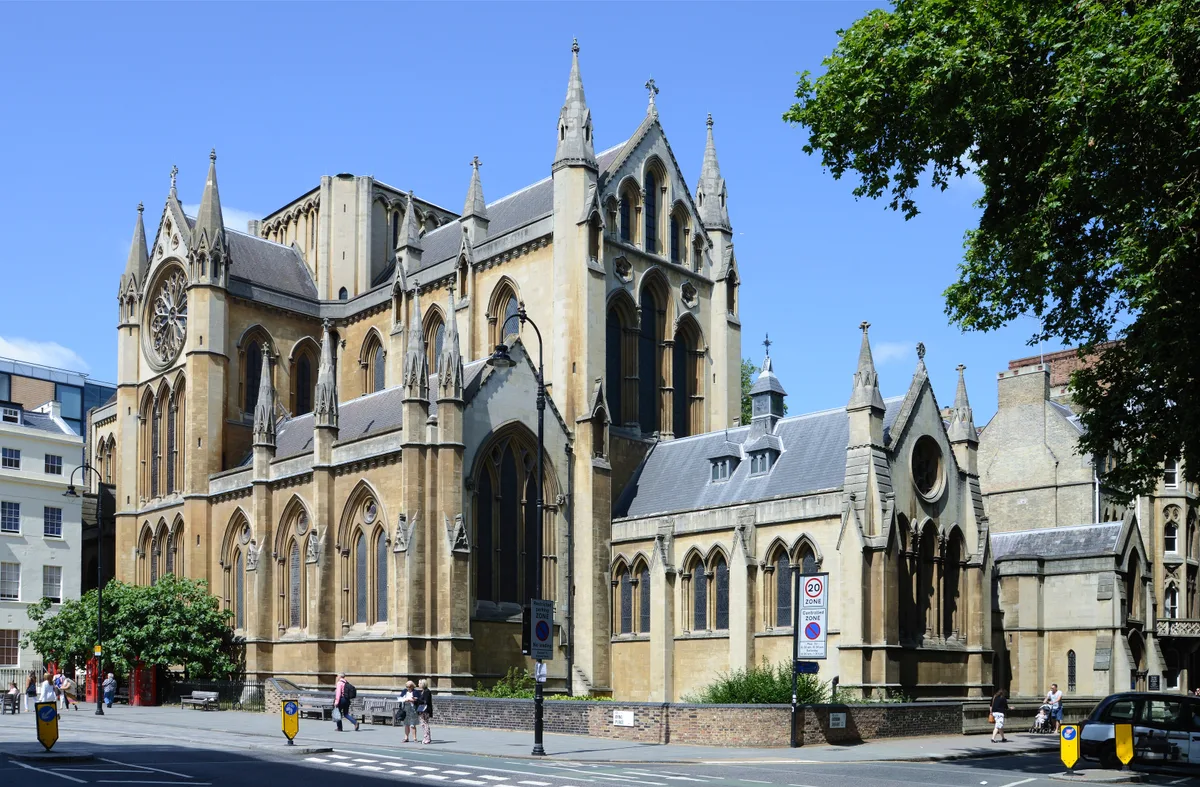
Church of Christ the King, Bloomsbury
Historic churches · 0.1 km

Noor Inayat Khan
Memorials & monuments · 0.1 km

Jeremy Bentham Auto-icon
Memorials & monuments · 0.1 km

Foster Court
Memorials & monuments · 0.1 km

Japan Modernisation
Memorials & monuments · 0.1 km

Bloomsbury Theatre
Open-air theatres · 0.1 km
Nearby
📷 5Public art & sculpture · London
Memorial to Rabindranath Tagore
Memorial to Rabindranath Tagore in England London, United Kingdom.
📷 5Memorials & monuments · London
Robert Travers Herford
Robert Travers Herford — a memorial in england-london, United Kingdom.
📷 5Memorials & monuments · London
John Maynard Keynes
John Maynard Keynes — a memorial in england-london, United Kingdom.
📷 5Public art & sculpture · London
Bust of Noor Inayat Khan
Bust of Noor Inayat Khan in England London, United Kingdom.
📷 5Memorials & monuments · London
Lytton Strachey
Lytton Strachey — a memorial in england-london, United Kingdom.
📷 5Memorials & monuments · London
Stone Gateway In Grounds Of University College Behind Number 17 Gordon Square
Stone Gateway In Grounds Of University College Behind Number 17 Gordon Square — Grade II listed building-listed memorial in england-london, United Kingdom.
Where to eat & stay near Rabindranath Tagore
Places to stay
 📷 7
📷 7Hotels · London
Royal National Hotel
Royal National Hotel — a hotel in england london.
 📷 5
📷 5 📷 5
📷 5 📷 5
📷 5 📷 7
📷 7Hotels · London
Kimpton Fitzroy London Hotel
Kimpton Fitzroy London Hotel — a hotel in england london. 5-star. Brand: Kimpton.
 📷 5
📷 5Places to eat & drink
 📷 5
📷 5Historic pubs · London
The Huntley
The Huntley — Historic pub — listed building or notable heritage status.
 📷 5
📷 5Cafés · London
Russell Square Cabmen's Shelter
Russell Square Cabmen's Shelter — a café in england london.
 📷 5
📷 5Historic pubs · London
Crown and Anchor
Crown and Anchor in England London, United Kingdom.
 📷 5
📷 5 📷 5
📷 5 📷 7
📷 7More memorials in this region
.jpg?width=1200) 📷 5
📷 5Memorials & monuments · London
1st Surrey Rifles War Memorial
1st Surrey Rifles War Memorial is a memorial in the United Kingdom.
 📷 5
📷 5Memorials & monuments · London
24th East Surrey Division War Memorial
24th East Surrey Division War Memorial is a memorial in the United Kingdom.
 📷 5
📷 5Memorials & monuments · London
Abney Park Cemetery CWGC Cross
Abney Park Cemetery CWGC Cross is a memorial in the United Kingdom.
 📷 5
📷 5Memorials & monuments · London
Admiral Sir John Franklin
Admiral Sir John Franklin is a memorial in the United Kingdom.
Frequently asked questions
- Where is Rabindranath Tagore?
- Rabindranath Tagore is in London, United Kingdom (postcode WC1E 6BT), in the parish of Camden, unparished area.
- What is Rabindranath Tagore?
- Rabindranath Tagore — a memorial in england-london, United Kingdom.
- How do I get to Rabindranath Tagore?
- The nearest railway station is Euston Square, about 0.4 km away. The nearest town is Covent Garden. Drivers can use postcode WC1E 6BT.
- Is Rabindranath Tagore free to visit?
- Yes, Rabindranath Tagore is free to enter.
- How do I get to Rabindranath Tagore?
- The nearest railway station is Euston Square, about 0.4 km away. Drivers can navigate to postcode WC1E 6BT.