
Public art & sculpture · South East England
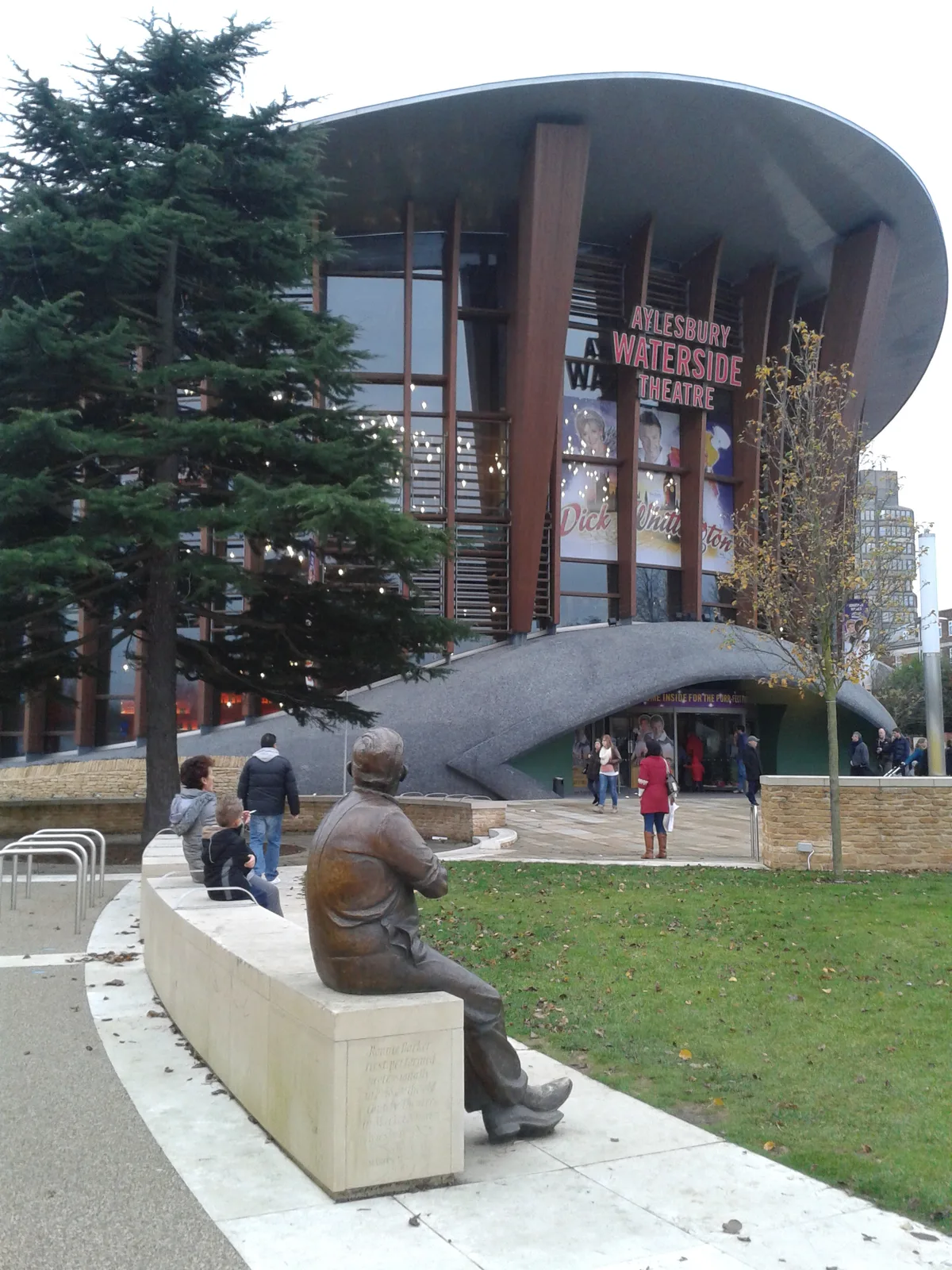
Ronnie Barker
In or near Stoke Mandeville.
Ronnie Barker — a public art in england-west-midlands, United Kingdom.

Philip Halling — CC BY-SA 2.0 via Wikimedia Commons licence

Plan your visit
- Typical visit
- 1 h–2 h
- Nearest railway station
- Aylesbury · 0.4 km
- Free entry
- Dog-friendly
- Limited wheelchair access
Getting there & planning your visit
To visit the public art dedicated to Ronnie Barker, you can take a train to Aylesbury station, which is 0.4 km away. Entry is free, but please note that wheelchair accessibility is limited. The postcode for your sat-nav is HP20 1UG.
About
Ronnie Barker is a public art located in england-west-midlands, United Kingdom. Sourced from OpenStreetMap (ODbL licence); see local listings for visitor information, opening hours and admission details.
Photo gallery
See it from the streetimagery from 2026
Imagery © Mapillary contributors, CC BY-SA 4.0
Official information
Aylesbury Waterside Theatre is a vibrant venue located in Aylesbury, known for hosting a variety of performances including West End productions, comedy shows, and children's entertainment. The theatre also serves as a space for conferences and live screenings, making it a multifunctional hub for the community.
Protected designations
- Area of Outstanding Natural Beauty: Chilterns
Designations sourced from Natural England open data under OGL v3.
From the Wikipedia article
Ronald William George Barker (25 September 1929 – 3 October 2005) was an English actor, comedian and writer. He was known for roles in British comedy television series such as The Frost Report, The Two Ronnies, Porridge, and Open All Hours. Barker began acting in Oxford amateur dramatics while working as a bank clerk, having dropped out of higher education. He moved into repertory theatre with the Aylesbury Repertory Company and decided he was best suited to comic roles. He had his first success at the Oxford Playhouse and in roles in the West End including Tom Stoppard's The Real Inspector Hound. During this period, he was in the cast of several BBC radio and television comedies, most notably the radio sitcom The Navy Lark. He got his television break with David Frost's satirical sketch series The Frost Report (1966–67), where he worked with John Cleese and Ronnie Corbett, the latter becoming Barker's long-time comedy partner. He joined Frost's production company and starred in several ITV shows during the late 1960s. After rejoining the BBC in the early 1970s, Barker and Corbett achieved significant success with the sketch show The Two Ronnies (1971–87). The duo maintained their careers as solo performers; Barker notably starred as inmate Norman Stanley Fletcher in the sitcom Porridge (1974–77) and its sequel Going Straight (1978) and as shopkeeper Arkwright in the sitcom Open All Hours (1976–85). He wrote comedy under his own name, though for much of his written material after 1968 he adopted pseudonyms (including "Gerald Wiley") to avoid pre-judgment of his writing talent. He won a BAFTA for best light entertainment performance four times, among other awards, and was appointed an OBE in 1978. Barker's later sitcoms such as The Magnificent Evans (1984) and Clarence (1988) were less successful and he retired in December 1987. The following year, he opened an antiques shop with his wife, Joy. After 1999, he appeared in smaller, non-comic roles in films. He died of heart failure on 3 October 2005, aged 76.
Excerpt from Wikipedia under CC BY-SA 4.0. See the source article linked in Sources below.
Background
Description
Barker failed to get into the Young Vic School, He appeared in stage adaptations of Treasure Island and Red Riding Hood before getting his first leading role in The Guinea Pig as a working-class boy at a public school. He made his way back to Oxford and then worked in Bramhall for the Famous Players. Barker joined the Oxford Playhouse in 1951 and worked there for three years, appearing in plays such as He Who Gets Slapped as Polly. Peter Hall worked with Barker at Oxford and gave him his break, casting him as the Chantyman and Joe Silva in his production of Mourning Becomes Electra at the Arts Theatre in London's West End in 1955. His other roles included Mr. Thwaites in Double Image in…
Sourced from Wikipedia under CC BY-SA 4.0.
- Coordinates
- 51.8152, -0.8087
- District
- Buckinghamshire
- Parish
- Aylesbury
- Postcode
- HP20 1UG
- Parliamentary constituency
- Aylesbury
- Nearest railway station
- Aylesbury — 0.4 km
- Official site
- watersidetheatreaylesbury.com
Sources
- osm: node/4825726308 (ODbL)
- wikipedia: Ronnie Barker (CC BY-SA 4.0)
Other places nearby
Waterside Theatre
Theatres · 0.1 km

Aylesbury Canal Arm
Canals · 0.1 km

Odeon Multiplex Cinema
Cinemas · 0.1 km

Aurelia Aylesbury
Restaurants · 0.2 km

Granada Aylesbury
Theatres · 0.2 km

David Bowie
Memorials & monuments · 0.2 km
Charles Compton
Memorials & monuments · 0.2 km
Cattle Trough Association
Memorials & monuments · 0.3 km

Market Theatre
Theatres · 0.3 km
Aylesbury
Museums · 0.3 km
Aylesbury Waterside Theatre
Open-air theatres · 0.3 km
Benjamin Disraeli
Memorials & monuments · 0.3 km
Nearby
📷 3Theatres · South East England
Waterside Theatre
Waterside Theatre is a theatre in the United Kingdom.
📷 3Canals · South East England
Aylesbury Canal Arm
Aylesbury Canal Arm — canal in the United Kingdom.
📷 5Cinemas · South East England
Odeon Multiplex Cinema
Odeon Multiplex Cinema — a cinema in england west midlands.
📷 7Restaurants · South East England
Aurelia Aylesbury
Aurelia Aylesbury — a restaurant in england west midlands. Cuisine: italian;breakfast;pizza;coffee shop;mediterranean;diner;brunch;bistro. 5-star.
📷 5Theatres · South East England
Granada Aylesbury
Granada Aylesbury in England South East, United Kingdom.
📷 4Memorials & monuments · South East England
David Bowie
David Bowie — a memorial in england-west-midlands, United Kingdom.
Where to eat & stay near Ronnie Barker
Places to stay
 📷 5
📷 5Campsites · South East England
Orchard View Farm
Orchard View Farm — a campsite in england west midlands.
 📷 5
📷 5Hotels · South East England
Bel & The Dragon at the Red Lion
Bel & The Dragon at the Red Lion — a hotel in england west midlands. Brand: Fuller's.
 📷 5
📷 5Campsites · South East England
Hill Farm Campsite
Hill Farm Campsite — a campsite in england west midlands.
 📷 7
📷 7Hotels · South East England
The Five Arrows Hotel
The Five Arrows Hotel — a hotel in england west midlands.
 📷 4
📷 4 📷 3
📷 3Places to eat & drink
📷 7Restaurants · South East England
Aurelia Aylesbury
Aurelia Aylesbury — a restaurant in england west midlands. Cuisine: italian;breakfast;pizza;coffee shop;mediterranean;diner;brunch;bistro. 5-star.
 📷 5
📷 5Restaurants · South East England
La Salute
La Salute — a restaurant in england west midlands.
 📷 5
📷 5Historic pubs · South East England
King's Head Inn
King's Head Inn in England South East, United Kingdom.
📷 5Restaurants · South East England
Top Friars
Top Friars — a restaurant in england west midlands.
 📷 5
📷 5Historic pubs · South East England
The Buckingham Arms
The Buckingham Arms in England South East, United Kingdom.
 📷 5
📷 5Historic pubs · South East England
The Foresters Arms Public House
The Foresters Arms Public House in England South East, United Kingdom.
More places in this region
 📷 5
📷 5Public art & sculpture · South East England
The Jurors
The Jurors — Public artwork (installation) by Hew Locke.
 📷 5
📷 5Public art & sculpture · South East England
The Woking Martian
The Woking Martian — a public art in england-london, United Kingdom.
 📷 5
📷 5Public art & sculpture · South East England
The Golf Ball
The Golf Ball — a public art in england-london, United Kingdom.
 📷 5
📷 5Public art & sculpture · South East England
Memorial to Alan Turing
Memorial to Alan Turing — a public art in england-london, United Kingdom.
Frequently asked questions
- Where is Ronnie Barker?
- Ronnie Barker is in South-East England, United Kingdom (postcode HP20 1UG), in the parish of Aylesbury.
- What is Ronnie Barker?
- Ronnie Barker — a public art in england-west-midlands, United Kingdom.
- How do I get to Ronnie Barker?
- The nearest railway station is Aylesbury, about 0.4 km away. The nearest town is Stoke Mandeville. Drivers can use postcode HP20 1UG.
- Is Ronnie Barker a protected site?
- Yes — Ronnie Barker is part of the Chilterns National Landscape (AONB).
- Is Ronnie Barker free to visit?
- Yes, Ronnie Barker is free to enter.
- How do I get to Ronnie Barker?
- The nearest railway station is Aylesbury, about 0.4 km away. Drivers can navigate to postcode HP20 1UG.