
Public art & sculpture · West Midlands
Pelican
In or near Birmingham.
Pelican — a public art in england-west-midlands, United Kingdom.

P L Chadwick — CC BY-SA 2.0 via Wikimedia Commons licence

Plan your visit
- Typical visit
- 1 h–2 h
- Nearest railway station
- Jewellery Quarter · 0.3 km
- Free entry
- Dog-friendly
Getting there & planning your visit
To visit Pelican in Birmingham, the nearest railway station is Jewellery Quarter, located 0.3 km away. Entry is free, and the postcode for sat-nav is B19 3BH.
About
Pelican is a public art located in england-west-midlands, United Kingdom. Sourced from OpenStreetMap (ODbL licence); see local listings for visitor information, opening hours and admission details.
Photo gallery
From the Wikipedia article
Pelicans (genus Pelecanus) are a genus of large water birds that make up the family Pelecanidae. They are characterized by a long beak and a large throat pouch used for catching prey and draining water from the scooped-up contents before swallowing. They have predominantly pale plumage, except for the brown and Peruvian pelicans. The bills, pouches, and bare facial skin of all pelicans become brightly coloured before the breeding season. The eight living pelican species have a patchy, seasonally-dependent yet global distribution, ranging latitudinally from the tropics to the temperate zone. Pelicans are absent from interior Amazonian South America, from polar regions and the open ocean; at least one species is known to migrate to the inland desert of Australia's Red Centre, after heavy rains create temporary lakes. White pelicans are also observed at the American state of Utah's Great Salt Lake, for example, some 600 miles (965 km) from the nearest coastline (the Pacific West Coast). They have also been seen hundreds of miles inland in North America, having flown northwards along the Mississippi River and other large waterways. Long thought to be related to frigatebirds, cormorants, tropicbirds, and gannets and boobies, pelicans instead are most closely related to the shoebill and hamerkop storks (although these two birds are not actually true storks), and are placed in the order Pelecaniformes. Ibises, spoonbills, herons, and bitterns have been classified in the same order. Fossil evidence of pelicans dates back at least 36 million years to the remains of a tibiotarsus recovered from late Eocene strata of Egypt that bears striking similarity to modern species of pelican. They are thought to have evolved in the Old World and spread into the Americas; this is reflected in the relationships within the genus as the eight species divide into Old World and New World lineages. This hypothesis is supported by fossil evidence from the oldest pelican taxa. Pelicans will frequent inland waterways but are most known for residing along maritime and coastal zones, where they feed principally on fish in their large throat pouches, diving into the water and catching them at/near the water's surface. They can adapt to varying degrees of water salinity, from freshwater and brackish to—most commonly—seawater. They are gregarious birds, travelling in flocks, hunting cooperatively, and breeding colonially. Four white-plumaged species tend to nest on the ground, and four brown or grey-plumaged species nest mainly in trees. The relationship between pelicans and people has often been contentious. The birds have been persecuted because of their perceived competition with commercial and recreational fishing. Their populations have fallen through habitat destruction, disturbance, and environmental pollution, and three species are of conservation concern. They also have a long history of cultural significance in mythology, and in Christian and heraldic iconography.
Excerpt from Wikipedia under CC BY-SA 4.0. See the source article linked in Sources below.
Background
Description
. The knob on its bill develops before the breeding season.]] with a chick in a nest in Chesapeake Bay, Maryland, US. This species will nest on the ground when no suitable trees are available.]] displaying the extent of its throat pouch (Lakes Entrance, Victoria)]] Pelicans are very large birds with very long bills characterised by a downcurved hook at the end of the upper mandible, and the attachment of a huge gular pouch to the lower. The slender rami of the lower bill and the flexible tongue muscles form the pouch into a basket for catching fish, and sometimes rainwater, They have a long neck and short stout legs with large, fully webbed feet. Although they are among the heaviest of…
Sourced from Wikipedia under CC BY-SA 4.0.
- Coordinates
- 52.4907, -1.9098
- District
- Birmingham
- Parish
- Birmingham, unparished area
- Postcode
- B19 3BH
- Parliamentary constituency
- Birmingham Ladywood
- Nearest railway station
- Jewellery Quarter — 0.3 km
Sources
- osm: node/1135747824 (ODbL)
- wikipedia: Pelican (CC BY-SA 4.0)
Other places nearby

The Lord Clifden
Historic pubs · 0.1 km

Jewellery Quarter Gateway: ‘With Love From'
Public art & sculpture · 0.1 km

Sterling-K House
Historic pubs · 0.1 km
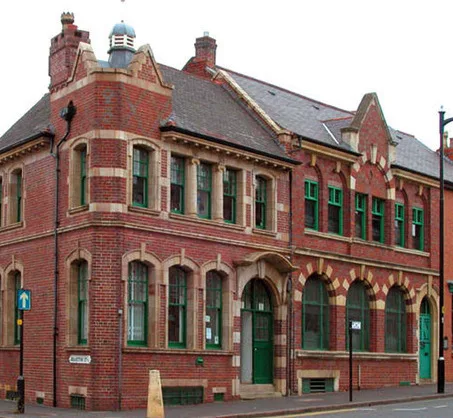
Museum of the Jewellery Quarter
Museums · 0.1 km

The Jewellers Arms
Historic pubs · 0.2 km

Gates to Jewellery Business Centre
Public art & sculpture · 0.2 km

The Church
Historic pubs · 0.2 km

Blue Orange Theatre
Open-air theatres · 0.2 km

Blue Orange Theatre
Theatres · 0.2 km

Reindeers
Public art & sculpture · 0.2 km

Jewellery Quarter Gateway: ‘Origins Of'
Public art & sculpture · 0.2 km

Clockwork (Jewellery Quarter Interchange)
Public art & sculpture · 0.2 km
Nearby
📷 3Historic pubs · West Midlands
The Lord Clifden
The Lord Clifden — Historic pub — listed building or notable heritage status.
📷 3Public art & sculpture · West Midlands
Jewellery Quarter Gateway: ‘With Love From'
Jewellery Quarter Gateway: ‘With Love From' — Public artwork (sculpture) by Anuradha Patel;Form Fabrications (Birmingham) Ltd..
📷 4Historic pubs · West Midlands
Sterling-K House
Sterling-K House — Historic pub — listed building or notable heritage status.
📷 3Museums · West Midlands
Museum of the Jewellery Quarter
Museum of the Jewellery Quarter — former jewellery factory, preserved as a museum of jewellery making.
📷 3Historic pubs · West Midlands
The Jewellers Arms
The Jewellers Arms — Historic pub — listed building or notable heritage status.
📷 3Public art & sculpture · West Midlands
Gates to Jewellery Business Centre
Gates to Jewellery Business Centre — a public art in england-west-midlands, United Kingdom.
Where to eat & stay near Pelican
Places to stay
 📷 7
📷 7Hotels · West Midlands
Hampton by Hilton Birmingham Jewellery Quarter
Hampton by Hilton Birmingham Jewellery Quarter — a hotel in england west midlands. 3-star. Brand: Hampton.
 📷 5
📷 5 📷 5
📷 5 📷 5
📷 5Hotels · West Midlands
Hyatt Regency Birmingham
Hyatt Regency Birmingham — a hotel in england west midlands. 4-star. Brand: Hyatt Regency.
 📷 5
📷 5 📷 5
📷 5Hotels · West Midlands
Leonardo Royal Hotel
Leonardo Royal Hotel — a hotel in england west midlands. Brand: Leonardo Royal Hotel.
Places to eat & drink
📷 3Historic pubs · West Midlands
The Lord Clifden
The Lord Clifden — Historic pub — listed building or notable heritage status.
📷 4Historic pubs · West Midlands
Sterling-K House
Sterling-K House — Historic pub — listed building or notable heritage status.
📷 3Historic pubs · West Midlands
The Jewellers Arms
The Jewellers Arms — Historic pub — listed building or notable heritage status.
📷 3Historic pubs · West Midlands
The Church
The Church — Historic pub — listed building or notable heritage status.
 📷 4
📷 4Historic pubs · West Midlands
White House
White House — Historic pub — listed building or notable heritage status.
📷 3Historic pubs · West Midlands
Rose Villa Tavern
Rose Villa Tavern — Historic pub — listed building or notable heritage status.
More places in this region
 📷 3
📷 3Public art & sculpture · West Midlands
Colin Grazier Memorial
Colin Grazier Memorial in England East Midlands, United Kingdom.
 📷 3
📷 3Public art & sculpture · West Midlands
The Rescue Miner
The Rescue Miner — a public art in england-east-midlands, United Kingdom.
📷 3Public art & sculpture · West Midlands
The Brereton Miner
The Brereton Miner — a public art in england-east-midlands, United Kingdom.
📷 3Public art & sculpture · West Midlands
The Deputy Miner
The Deputy Miner — a public art in england-east-midlands, United Kingdom.
Frequently asked questions
- Where is Pelican?
- Pelican is in the West Midlands, United Kingdom (postcode B19 3BH), in the parish of Birmingham, unparished area.
- What is Pelican?
- Pelican — a public art in england-west-midlands, United Kingdom.
- How do I get to Pelican?
- The nearest railway station is Jewellery Quarter, about 0.3 km away. The nearest town is Birmingham. Drivers can use postcode B19 3BH.
- Is Pelican free to visit?
- Yes, Pelican is free to enter.
- How do I get to Pelican?
- The nearest railway station is Jewellery Quarter, about 0.3 km away. Drivers can navigate to postcode B19 3BH.