
Public art & sculpture · Northern Ireland
Parabolic reflectors
In or near Armagh.
Parabolic reflectors — a public art in northern-ireland, United Kingdom.

Eric Jones — CC BY-SA 2.0 via Wikimedia Commons licence

Plan your visit
- Typical visit
- 1 h–2 h
- Free entry
- Dog-friendly
About
Parabolic reflectors is a public art located in northern-ireland, United Kingdom. Sourced from OpenStreetMap (ODbL licence); see local listings for visitor information, opening hours and admission details.
Photo gallery
Official information
The Royal Irish Fusiliers Museum is dedicated to preserving the history and legacy of the Royal Irish Fusiliers and related regiments. It features a range of military artifacts, personal stories, and archival materials that provide insight into the experiences of those who served. The museum also serves as a center for historical research and community engagement.
From the Wikipedia article
A parabolic (or paraboloid or paraboloidal) reflector (or dish or mirror) is a reflective surface used to collect or project energy such as light, sound, or radio waves. Its shape is part of a circular paraboloid, that is, the surface generated by a parabola revolving around its axis. The parabolic reflector transforms an incoming plane wave travelling along the axis into a spherical wave converging toward the focus. Conversely, a spherical wave generated by a point source placed in the focus is reflected into a plane wave propagating as a collimated beam along the axis. Parabolic reflectors are used to collect energy from a distant source (for example sound waves or incoming star light). Since the principles of reflection are reversible, parabolic reflectors can also be used to collimate radiation from an isotropic source into a parallel beam. In optics, parabolic mirrors are used to gather light in reflecting telescopes and solar furnaces, and project a beam of light in flashlights, searchlights, stage spotlights, and car headlights. In radio, parabolic antennas are used to radiate a narrow beam of radio waves for point-to-point communications in satellite dishes and microwave relay stations, and to locate aircraft, ships, and vehicles in radar sets. In acoustics, parabolic microphones are used to record faraway sounds such as bird calls, in sports reporting, and to eavesdrop on private conversations in espionage and law enforcement.
Excerpt from Wikipedia under CC BY-SA 4.0. See the source article linked in Sources below.
Background
History
The principle of parabolic reflectors has been known since classical antiquity, when the mathematician Diocles described them in his book On Burning Mirrors and proved that they focus a parallel beam to a point.
Description
Strictly, the three-dimensional shape of the reflector is called a paraboloid. A parabola is the two-dimensional figure. (The distinction is like that between a sphere and a circle.) However, in informal language, the word parabola and its associated adjective parabolic are often used in place of paraboloid and paraboloidal. If a parabola is positioned in Cartesian coordinates with its vertex at the origin and its axis of symmetry along the y-axis, so the parabola opens upward, its equation is <math display="inline">4fy = x^2</math>, where <math display="inline"> f</math> is its focal length. (See "Parabola#In a cartesian coordinate system".) Correspondingly, the dimensions of a symmetrical…
Sourced from Wikipedia under CC BY-SA 4.0.
- Coordinates
- 54.3531, -6.6482
- Postcode
- BT61 9DF
- Parliamentary constituency
- Newry and Armagh
Sources
- osm: node/9889003580 (ODbL)
- wikipedia: Parabolic reflector (CC BY-SA 4.0)
Other places nearby
The Inner Solar System
Public art & sculpture · 0.0 km
Human Orrery
Public art & sculpture · 0.1 km
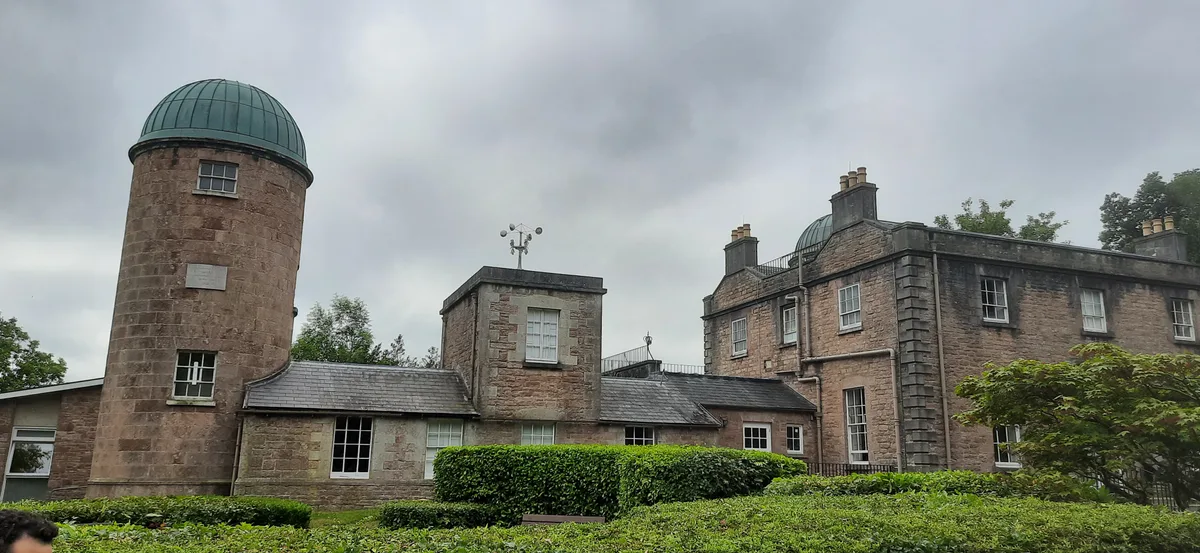
Armagh Observatory
Observatories · 0.1 km

The Royal School, Armagh
Natural landmarks · 0.1 km
Armagh Planetarium
Observatories · 0.1 km
The Stone Circle
Public art & sculpture · 0.2 km
Neptune and Pluto
Public art & sculpture · 0.2 km
Hypercube
Public art & sculpture · 0.2 km

Southern Regional College
Natural landmarks · 0.3 km

County Armagh
Natural landmarks · 0.4 km

Royal Irish Fusiliers Museum
Museums · 0.4 km
.jpg?width=1200)
1 Charlemont Place
Historic houses · 0.4 km
Nearby
📷 3Public art & sculpture · Northern Ireland
The Inner Solar System
The Inner Solar System — a public art in northern-ireland, United Kingdom.
📷 3Public art & sculpture · Northern Ireland
Human Orrery
Human Orrery — a public art in northern-ireland, United Kingdom.
📷 3Observatories · Northern Ireland
Armagh Observatory
Armagh Observatory — observatory in Armagh, County Armagh, Northern Ireland.
📷 5Natural landmarks · Northern Ireland
The Royal School, Armagh
The Royal School, Armagh in Northern Ireland, United Kingdom.
📷 5Observatories · Northern Ireland
Armagh Planetarium
Armagh Planetarium in Northern Ireland, United Kingdom.
📷 3Public art & sculpture · Northern Ireland
The Stone Circle
The Stone Circle — a public art in northern-ireland, United Kingdom.
Where to eat & stay near Parabolic reflectors
Places to stay
 📷 5
📷 5 📷 5
📷 5 📷 4
📷 4Caravan parks · Northern Ireland
Clare Glen Caravan Park
Clare Glen Caravan Park — a caravan park in northern ireland.
 📷 5
📷 5Caravan parks · Northern Ireland
Dungannon Park Caravan & Camping
Dungannon Park Caravan & Camping — a caravan park in northern ireland.
 📷 5
📷 5Caravan parks · Northern Ireland
Dungannon Park Caravan & Camping
Dungannon Park Caravan & Camping — a caravan park in northern ireland.
 📷 5
📷 5Caravan parks · Northern Ireland
Kinnego Marina Camping & Caravanning
Kinnego Marina Camping & Caravanning — a caravan park in northern ireland.
Places to eat & drink
 📷 5
📷 5More places in this region
 📷 3
📷 3Public art & sculpture · Northern Ireland
Davagh Giant
Davagh Giant — Public artwork (statue) by Thomas Dembo.
 📷 3
📷 3Public art & sculpture · Northern Ireland
Greystone Roundabout Sculpture
Greystone Roundabout Sculpture — Public artwork (sculpture) by Positive Spaces Programme.
 📷 3
📷 3Public art & sculpture · Northern Ireland
International Sailor
International Sailor — Public artwork (sculpture) by Peter Bustin.
.jpg?width=1200) 📷 3
📷 3Public art & sculpture · Northern Ireland
Manannán mac Lir
Manannán mac Lir — Public artwork (sculpture).
Frequently asked questions
- Where is Parabolic reflectors?
- Parabolic reflectors is in Northern Ireland, United Kingdom (postcode BT61 9DF).
- What is Parabolic reflectors?
- Parabolic reflectors — a public art in northern-ireland, United Kingdom.
- How do I get to Parabolic reflectors?
- The nearest town is Armagh. Drivers can use postcode BT61 9DF.
- Is Parabolic reflectors free to visit?
- Yes, Parabolic reflectors is free to enter.
- How do I get to Parabolic reflectors?
- Drivers can navigate to postcode BT61 9DF. It sits within the Newry and Armagh parliamentary constituency.