
Aviation museums · East of England
Imperial War Museum Duxford
Also known as: IWM Duxford
In or near Duxford.
Britain's largest aviation museum, on a working WWII airfield south of Cambridge.

Roland Turner from Birmingham, Great Britain — CC BY-SA 2.0 via Wikimedia Commons licence
.jpg)
Plan your visit
- Typical visit
- 2 h–4 h
- Nearest railway station
- Whittlesford Parkway · 2.7 km
- Paid entry
- Family-friendly
- Limited wheelchair access
Getting there & planning your visit
To visit the Imperial War Museum Duxford, the nearest railway station is Whittlesford Parkway, located 2.7 km away. The postcode for sat-nav is CB22 4QR, and entry is paid. Accessibility is limited for wheelchair users.
About
IWM Duxford, on the former Battle of Britain airfield south of Cambridge, is the largest aviation museum in Britain and one of the largest in Europe. Six hangars hold over 200 aircraft from Spitfires to Concorde to a Lancaster, the only European Aerospace pavilion houses an SR-71 Blackbird and a U-2, and the air-show season (May-October) draws international visitors. Operates as a working airfield.
Photo gallery
Summary from the official site
IWM Duxford is a significant aviation museum located in Duxford, showcasing a vast collection of historic aircraft and military vehicles. Visitors can explore various exhibitions and experience immersive events related to aviation history and military conflicts.
Read more on the official property page.
From the Wikipedia article
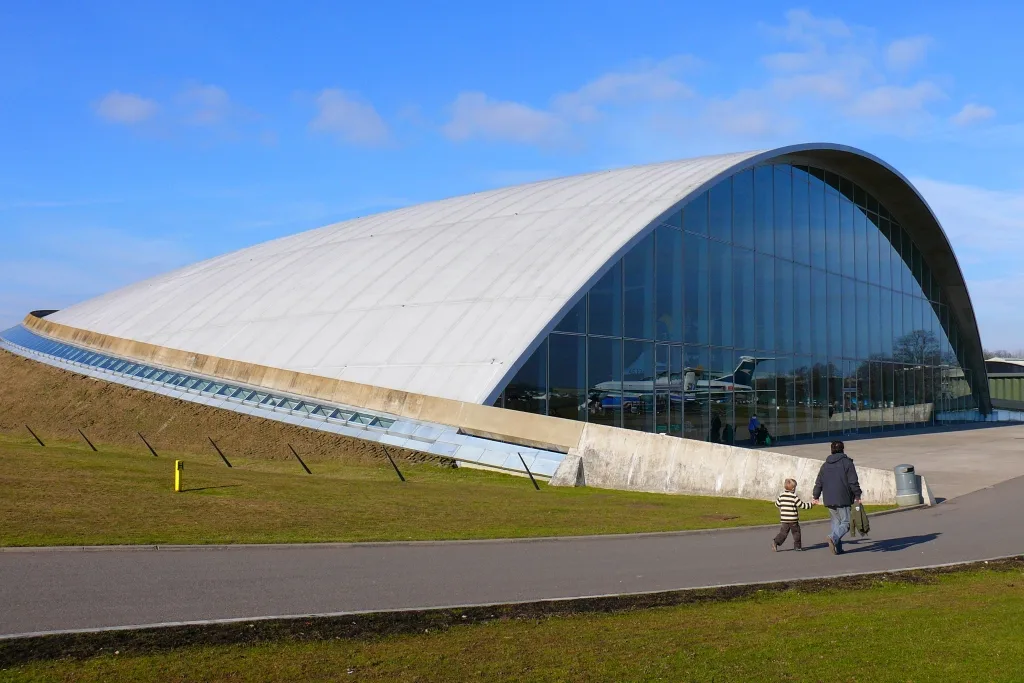
Imperial War Museum Duxford, also known as IWM Duxford or simply Duxford, is a branch of the Imperial War Museum near Duxford in Cambridgeshire, England. Duxford, Britain's largest aviation museum, houses exhibits, including nearly 200 aircraft, military vehicles, artillery and small naval vessels in seven main exhibition buildings. The site also provides storage space for the museum's other collections of material such as film, photographs, documents, books and artefacts. The site accommodates several British Army regimental museums, including those of the Parachute Regiment (named Airborne Assault) and the Royal Anglian Regiment. Based on the historic Duxford Aerodrome, the site was originally operated by the Royal Flying Corps in the First World War. During the Second World War, Duxford played a prominent role during the Battle of Britain and was used by United States Army Air Forces fighter units in support of the daylight bombing of Germany. Duxford remained an active RAF airfield until 1961. After the Ministry of Defence declared the site surplus to requirements in 1969, the Imperial War Museum received permission to use part of the site for storage. The entirety of the site was transferred to the museum in February 1976. In keeping with the site's history, many of Duxford's original buildings, such as hangars used during the Battle of Britain, are still in use. Many of these buildings are of particular architectural or historic significance and over thirty have listed building status, with Duxford reflecting two periods of development in both WW1 and the 1930s. The site also features several purpose-built exhibition buildings, such as the Stirling Prize-winning American Air Museum, designed by Sir Norman Foster. The site remains an active airfield and is used by civilian flying companies, and hosts regular air shows. The site is operated in partnership with Cambridgeshire County Council and the Duxford Aviation Society, a charity formed in 1975 to preserve…
Excerpt from Wikipedia under CC BY-SA 4.0. See the source article linked in Sources below.
Background
History
The Imperial War Museum originated during the First World War in 1917 as the National War Museum committee, formed by the British government to record the war effort and sacrifice of Britain and her Empire. The museum opened in 1920, by which point it had been renamed the Imperial War Museum. With the outbreak of the Second World War, the museum's terms of reference were enlarged to include that conflict as well. The museum's terms of reference was broadened again in 1953 to include all modern conflicts in which British or Commonwealth forces were engaged. The effect of these expansions of remit was to cause the museum's collections to expand enormously, to the point that many parts of the…
Architecture
The American Air Museum was designed by Norman Foster and Chris Wise at Arup. The museum's specification called for a landmark building that would provide a neutral backdrop for the aircraft collection and provide appropriate climatic controls while being cost efficient to operate. The building is shaped as a section of a torus, formed from a curved concrete roof 90 m wide, 18.5 m high and 100 m deep. The dimensions of the building were dictated by the need to accommodate the museum's B-52 Stratofortress bomber with its 61 m wingspan and a tail 16 m high. The roof was constructed as a double-layered concrete shell, built in 924 precast reinforced concrete sections. Inverted T-shaped…
Visiting
, left foreground, B-52 cockpit, right foreground, and SPAD S.XIII, PT-17 and A-10 Thunderbolt II, suspended above.]] The American Air Museum was opened by Queen Elizabeth II on 1 August 1997. The total cost of the project had been £13.5 million. and Consolidated B-24 Liberator. The SR-71, serial number 61-7962, is the only example of its type on display outside the United States, and set a flight altitude record of 85,069 feet (25,929m) in July 1976. Besides the Blackbird, nineteen other American aircraft are on display. Notable examples include a C-47 Skytrain which flew with the 316th Troop Carrier Group and participated in three major Second World War airborne operations; the June 1944…
Sourced from Wikipedia under CC BY-SA 4.0.
- Coordinates
- 52.0917, 0.1311
- County
- Cambridgeshire
- District
- South Cambridgeshire
- Parish
- Thriplow and Heathfield
- Postcode
- CB22 4QR
- Parliamentary constituency
- South Cambridgeshire
- Established
- 1977
- Annual visitors
- ~401,287/year
- Nearest railway station
- Whittlesford Parkway — 2.7 km
- Opening
- 10:00-16:00
- Official site
- www.iwm.org.uk
Sources
- manual: imperial-war-museum-duxford (manual)
- wikipedia: Imperial War Museum Duxford (CC BY-SA 4.0)
Other places nearby

IWM Duxford
Museums · 0.0 km

Britten-Norman Trislander
Museums · 0.2 km

Bristol Britannia
Museums · 0.2 km

Vickers Viscount
Museums · 0.2 km

British Aerospace 146
Museums · 0.2 km

Airspeed Ambassador
Museums · 0.2 km

Vickers VC-10
Museums · 0.2 km

Hawker Siddeley Trident
Museums · 0.3 km

British Airliner Collection
Museums · 0.4 km
American Air Museum
Museums · 0.4 km

Gibraltar Coastal Gun
Memorials & monuments · 0.4 km

Imperial War Museum Duxford 1940 Operations Room
Museums · 0.4 km
Nearby
📷 5Museums · East of England
IWM Duxford
IWM Duxford — a museum in england-london, United Kingdom.
📷 5Museums · East of England
Britten-Norman Trislander
Britten-Norman Trislander — a museum in england-london, United Kingdom.
📷 5Museums · East of England
Bristol Britannia
Bristol Britannia — a museum in england-london, United Kingdom.
📷 5Museums · East of England
Vickers Viscount
Vickers Viscount — a museum in england-london, United Kingdom.
📷 5Museums · East of England
British Aerospace 146
British Aerospace 146 — a museum in england-london, United Kingdom.
📷 5Museums · East of England
Airspeed Ambassador
Airspeed Ambassador — a museum in england-london, United Kingdom.
Where to eat & stay near Imperial War Museum Duxford
Places to stay
 📷 5
📷 5Caravan parks · East of England
Apple Acre Caravan Park
Apple Acre Caravan Park — a caravan park in england london.
 📷 5
📷 5 📷 5
📷 5Caravan parks · East of England
Caravan and Motorhome Club
Caravan and Motorhome Club — a caravan park in england london.
📷 5 📷 7
📷 7Hotels · East of England
Crown House
Crown House — a hotel in england london.
 📷 5
📷 5Places to eat & drink
 📷 5
📷 5Historic pubs · East of England
Tickells Arms Public House
Tickells Arms Public House in England East, United Kingdom.
 📷 5
📷 5Historic pubs · East of England
The Navigator
The Navigator in England East, United Kingdom.
 📷 5
📷 5 📷 7
📷 7Historic pubs · East of England
Old Carpenters Arms
Old Carpenters Arms in England East, United Kingdom.
 📷 5
📷 5Historic pubs · East of England
Woodman Public House
Woodman Public House in England East, United Kingdom.
 📷 7
📷 7Restaurants · East of England
sole & duck
sole & duck — a restaurant in england london.
Frequently asked questions
- Where is Imperial War Museum Duxford?
- Imperial War Museum Duxford is in Cambridgeshire, East of England, United Kingdom (postcode CB22 4QR), in the parish of Thriplow and Heathfield.
- What is Imperial War Museum Duxford?
- Britain's largest aviation museum, on a working WWII airfield south of Cambridge.
- How do I get to Imperial War Museum Duxford?
- The nearest railway station is Whittlesford Parkway, about 2.7 km away. The nearest town is Duxford. Drivers can use postcode CB22 4QR.
- When was Imperial War Museum Duxford built?
- Built or established in 1977.
- Who owns Imperial War Museum Duxford?
- Imperial War Museum Duxford is owned by Imperial War Museums.
- How do I get to Imperial War Museum Duxford?
- The nearest railway station is Whittlesford Parkway, about 2.7 km away. Drivers can navigate to postcode CB22 4QR.
- How busy is Imperial War Museum Duxford?
- Imperial War Museum Duxford draws around 401,287 visitors a year.