
Public art & sculpture · London
Hydraulic Ram
In or near City of London.
Hydraulic Ram — a public art in england-london, United Kingdom.

N Chadwick — CC BY-SA 2.0 via Wikimedia Commons licence

Plan your visit
- Typical visit
- 1 h–2 h
- Nearest railway station
- Mudchute · 0.8 km
- Free entry
- Dog-friendly
Getting there & planning your visit
To visit the Hydraulic Ram, the nearest railway station is Mudchute, located 0.8 km away. The postcode is E14 3SE. Entry is free.
About
Hydraulic Ram is a public art located in england-london, United Kingdom. Sourced from OpenStreetMap (ODbL licence); see local listings for visitor information, opening hours and admission details.
Photo gallery
See it from the streetimagery from 2019
Imagery © Mapillary contributors, CC BY-SA 4.0
From the Wikipedia article
A hydraulic ram pump, ram pump, or hydram is a cyclic water pump powered by hydropower. It takes in water at one "hydraulic head" (pressure) and flow rate, and outputs water at a higher hydraulic head and lower flow rate. The device uses the water hammer effect to develop pressure that allows a portion of the input water that powers the pump to be lifted to a point higher than where the water originally started. The hydraulic ram is sometimes used in remote areas, where there is both a source of low-head hydropower and a need for pumping water to a destination higher in elevation than the source. In this situation, the ram is often useful, since it requires no outside source of power other than the kinetic energy of flowing water.
Excerpt from Wikipedia under CC BY-SA 4.0. See the source article linked in Sources below.
Background
History
]], Nordjylland, Denmark]] , Warmia, Poland]] In 1772, John Whitehurst of Cheshire, England, invented a manually controlled precursor of the hydraulic ram called the "pulsation engine" and installed the first one at Oulton, Cheshire to raise water to a height of 4.9 m. In 1783, he installed another in Ireland. He did not patent it, and details are obscure, but it is known to have had an air vessel. The first self-acting ram pump was invented by the Frenchman Joseph Michel Montgolfier (best known as a co-inventor of the hot air balloon) in 1796 for raising water in his paper mill at Voiron. His friend Matthew Boulton took out a British patent on his behalf in 1797. The sons of Montgolfier…
Architecture
A traditional hydraulic ram has only two moving parts, a spring or weight loaded "waste" valve sometimes known as the "clack" valve and a "delivery" check valve, making it cheap to build, easy to maintain, and very reliable. Priestly's Hydraulic Ram, described in detail in the 1947 Encyclopedia Britannica, has no moving parts.
Sourced from Wikipedia under CC BY-SA 4.0.
- Coordinates
- 51.4938, -0.0259
- District
- Tower Hamlets
- Parish
- Tower Hamlets, unparished area
- Postcode
- E14 3SE
- Parliamentary constituency
- Poplar and Limehouse
- Nearest railway station
- Mudchute — 0.8 km
Sources
- osm: node/12915181830 (ODbL)
- wikipedia: Hydraulic ram (CC BY-SA 4.0)
Other places nearby
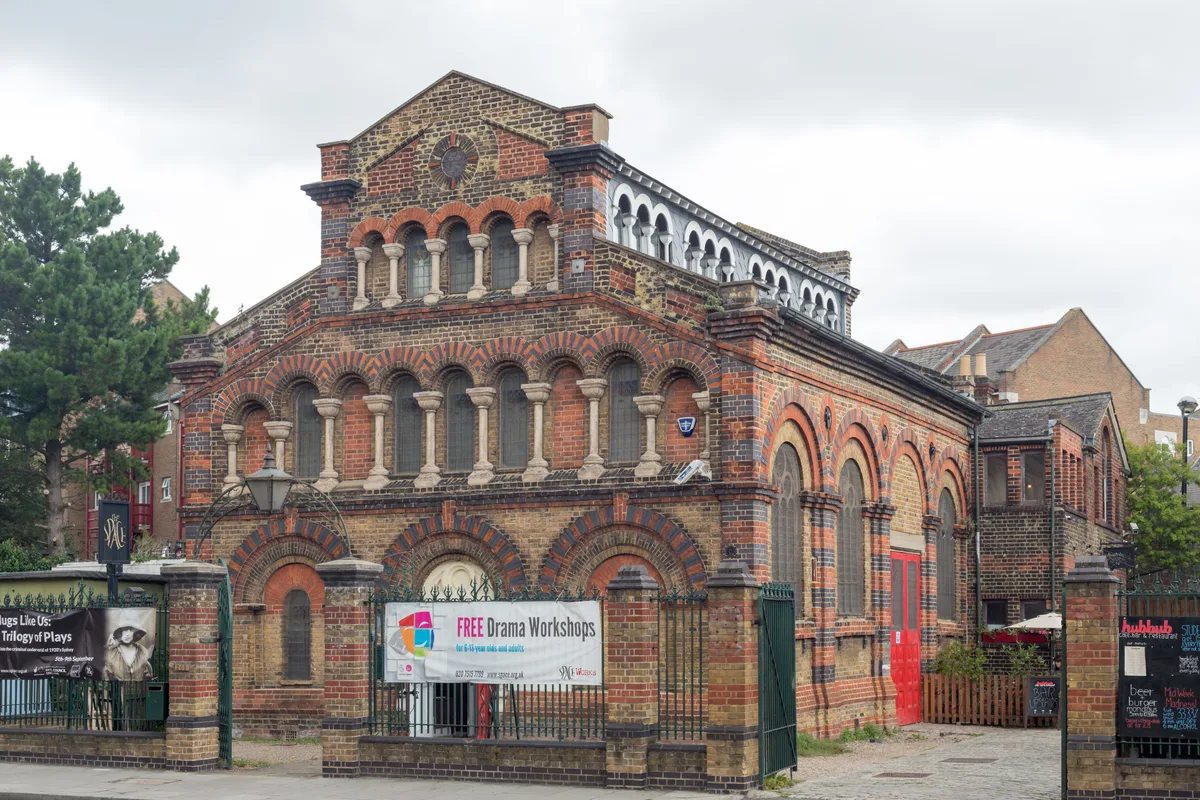
The Space
Theatres · 0.2 km

Docklands Sailing and Watersports Centre Open Water Swimming
Wild swimming spots · 0.3 km

Millwall Picture Theatre
Theatres · 0.3 km

Greenland Pier
Marinas · 0.4 km

Circumsphere
Public art & sculpture · 0.4 km

Greenland Pier
Piers · 0.5 km

Docklands Community Centre
Historic churches · 0.5 km

Wall of the Ancestors
Public art & sculpture · 0.5 km

Curlicue
Public art & sculpture · 0.5 km
_(49311359888).jpg?width=1200)
Curlicue
Heritage railway stations · 0.5 km
.jpg?width=1200)
Greenland Lock Including Gates, Bollards And Capstans
Canal locks · 0.6 km

In the Memory of the More Than 40 People Killed
Memorials & monuments · 0.6 km
Nearby
📷 5📷 5Wild swimming spots · London
Docklands Sailing and Watersports Centre Open Water Swimming
Docklands Sailing and Watersports Centre Open Water Swimming — a wild swimming in england london.
📷 5Theatres · London
Millwall Picture Theatre
Millwall Picture Theatre in England London, United Kingdom.
📷 5📷 5Public art & sculpture · London
Circumsphere
Circumsphere — a public art in england-london, United Kingdom.
📷 5Piers · London
Greenland Pier
Greenland Pier is a pier in the United Kingdom.
Where to eat & stay near Hydraulic Ram
Places to stay
 📷 5
📷 5Hotels · London
Lincoln Plaza London, Curio Collection by Hilton
Lincoln Plaza London, Curio Collection by Hilton — a hotel in england london. 4-star. Brand: Hilton.
 📷 7
📷 7Hotels · London
Novotel London Canary Wharf
Novotel London Canary Wharf — a hotel in england london.
 📷 5
📷 5Hotels · London
Hilton London Canary Wharf
Hilton London Canary Wharf — a hotel in england london.
 📷 5
📷 5Hotels · London
a&o London Docklands Riverside
a&o London Docklands Riverside — a hotel in england london.
 📷 5
📷 5Hotels · London
Canary Riverside Plaza Hotel
Canary Riverside Plaza Hotel — a hotel in england london.
 📷 5
📷 5Hotels · London
Marriott Executive Apartments
Marriott Executive Apartments — a hotel in england london. Brand: Marriott Executive Apartments.
Places to eat & drink
 📷 5
📷 5Historic pubs · London
The Waterman's Arms
The Waterman's Arms — Historic pub — listed building or notable heritage status.
 📷 5
📷 5 📷 5
📷 5Historic pubs · London
Charlie Brown's, Limehouse
Charlie Brown's, Limehouse in England London, United Kingdom.
 📷 7
📷 7 📷 5
📷 5Historic pubs · London
Trafalgar Tavern
Trafalgar Tavern in England London, United Kingdom.
 📷 7
📷 7Historic pubs · London
Greenwich Pensioner Public House
Greenwich Pensioner Public House in England London, United Kingdom.
More places in this region
 📷 5
📷 5 📷 5
📷 5Public art & sculpture · London
A Conversation with Oscar Wilde
A Conversation with Oscar Wilde — Public artwork (sculpture).
 📷 5
📷 5Public art & sculpture · London
A Sculpture for Mary Wollstonecraft
A Sculpture for Mary Wollstonecraft — Public artwork (sculpture) by Maggi Hambling.
 📷 5
📷 5Public art & sculpture · London
A Slice of Reality
A Slice of Reality — Public artwork (installation) by Richard Wilson.
Frequently asked questions
- Where is Hydraulic Ram?
- Hydraulic Ram is in London, United Kingdom (postcode E14 3SE), in the parish of Tower Hamlets, unparished area.
- What is Hydraulic Ram?
- Hydraulic Ram — a public art in england-london, United Kingdom.
- How do I get to Hydraulic Ram?
- The nearest railway station is Mudchute, about 0.8 km away. The nearest town is City of London. Drivers can use postcode E14 3SE.
- Is Hydraulic Ram free to visit?
- Yes, Hydraulic Ram is free to enter.
- How do I get to Hydraulic Ram?
- The nearest railway station is Mudchute, about 0.8 km away. Drivers can navigate to postcode E14 3SE.