
Battlefields & battle sites · Scottish Islands
HMS Royal Oak
In or near Finstown.
HMS Royal Oak in Orkney + Shetland, United Kingdom.

Ian Balcombe — CC BY-SA 2.0 via Wikimedia Commons licence

Plan your visit
- Typical visit
- 1 h–2 h
- Free entry
- Dog-friendly
About
HMS Royal Oak is a place of interest in Orkney + Shetland, United Kingdom — drawn from open-data sources for visitor reference. See the linked Wikipedia article for the full description.
Photo gallery
From the Wikipedia article
HMS Royal Oak was one of five Revenge-class battleships built for the Royal Navy during the First World War. Completed in 1916, the ship first saw combat at the Battle of Jutland as part of the Grand Fleet. In peacetime, she served in the Atlantic, Home and Mediterranean fleets, more than once coming under accidental attack. Royal Oak drew worldwide attention in 1928 when her senior officers were controversially court-martialled, an event that brought considerable embarrassment to what was then the world's largest navy. Attempts to modernise Royal Oak throughout her 25-year career could not fix her fundamental lack of speed and, by the start of the Second World War, she was no longer suitable for front-line duty. On 14 October 1939, Royal Oak was anchored at Scapa Flow in Orkney, Scotland, when she was torpedoed by the German submarine U-47. Of Royal Oak's complement of 1,234 men and boys, 835 were killed that night or died later of their wounds. The loss of the outdated ship—the first of five Royal Navy battleships and battlecruisers sunk in the Second World War—did little to affect the numerical superiority enjoyed by the British navy and its Allies, but it had a considerable effect on wartime morale. The raid made an immediate celebrity and war hero of the U-boat commander, Günther Prien, who became the first German submarine officer to be awarded the Knight's Cross of the Iron Cross. Before the sinking of Royal Oak, the Royal Navy had considered the naval base at Scapa Flow impregnable to submarine attack, but U-47's raid demonstrated that the German navy was capable of bringing the war to British home waters. The shock resulted in rapid changes to dockland security and the construction of the Churchill Barriers around Scapa Flow, with the added advantage of being topped by roads running between the islands. The wreck of Royal Oak, a designated war grave, lies almost upside down in 100 feet (30 m) of water with her hull 16 feet (4.9 m) beneath the surface. In…
Excerpt from Wikipedia under CC BY-SA 4.0. See the source article linked in Sources below.
Background
Architecture
The Revenge-class ships were designed as slightly smaller, slower, and more heavily protected versions of the preceding s. As an economy measure they were intended to revert to the previous practice of using both fuel oil and coal, but First Sea Lord Jackie Fisher rescinded the decision for coal in October 1914. While under construction the ships were redesigned to employ oil-fired boilers that increased the power of the engines by 9000 shp over the original specification. Royal Oak had a length overall of 620 ft, a beam of 88 ft and a deep draught of 33 ft. She had a designed displacement of 27790 LT and displaced 31130 LT at deep load. She was powered by two sets of Parsons steam…
Sourced from Wikipedia under CC BY-SA 4.0.
- Coordinates
- 58.9308, -2.9834
- Established
- 1916
Sources
- wikidata: Q620472 (CC0)
- wikipedia: HMS Royal Oak (08) (CC BY-SA 4.0)
Featured in this guide
Other places nearby

Gaitnip Hill
Mountains & hills · 1.7 km
Gaitnip Hill
Mountains & hills · 1.7 km

Bay of Deepdale
Natural landmarks · 1.8 km

Site of Sir Hugh's Seat
Archaeological sites · 2.1 km
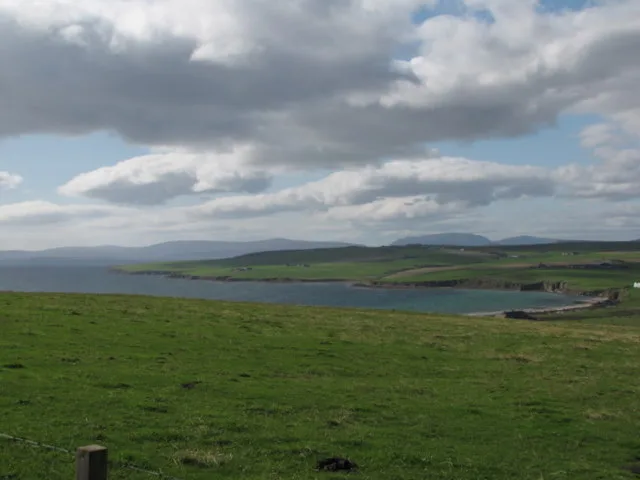
Scapa Bay
Mountains & hills · 2.1 km

Hesti Geo
Natural landmarks · 2.3 km
![Netherbutton RAF Radar Station [WW2]](https://upload.wikimedia.org/wikipedia/commons/thumb/e/e5/House_north_of_St_Mary%27s_on_Mainland%2C_Orkney_-_geograph.org.uk_-_7443317.jpg/1280px-House_north_of_St_Mary%27s_on_Mainland%2C_Orkney_-_geograph.org.uk_-_7443317.jpg?utm_source=commons.wikimedia.org&utm_campaign=imageinfo&utm_content=thumbnail)
Netherbutton RAF Radar Station [WW2]
Archaeological sites · 2.9 km

Scapa beach
Beaches · 3.2 km

Nether Button
Villages · 3.3 km

HMS Royal Oak Propeller
Memorials & monuments · 3.4 km
Squadron Commander Edwin Dunning Memorial
Memorials & monuments · 3.4 km
HMS Royal Oak Memorial Stone
Memorials & monuments · 3.4 km
Nearby
📷 5Mountains & hills · Scottish Islands
Gaitnip Hill
Gaitnip Hill — a hill or mountain in scotland islands.
📷 5Mountains & hills · Scottish Islands
Gaitnip Hill
Gaitnip Hill — mountain in scotland islands. Elevation: 101 m.
📷 5Natural landmarks · Scottish Islands
Bay of Deepdale
Bay of Deepdale — a natural feature in scotland islands.
📷 3Archaeological sites · Scottish Islands
Site of Sir Hugh's Seat
Site of Sir Hugh's Seat — a archaeological in scotland-islands, United Kingdom.
📷 5📷 5Where to eat & stay near HMS Royal Oak
Places to stay
 📷 5
📷 5Hostels · Scottish Islands
Lynnfield Hotel and Resturant
Lynnfield Hotel and Resturant — a hostel in scotland islands.
 📷 5
📷 5Hostels · Scottish Islands
Kirkwall Youth Hostel
Kirkwall Youth Hostel — a hostel in scotland islands. Brand: Hostelling Scotland.
 📷 7
📷 7 📷 5
📷 5Hostels · Scottish Islands
Orcades Hostel
Orcades Hostel — a hostel in scotland islands.
📷 5Caravan parks · Scottish Islands
Orkney Caravan Park at the Pickaquoy Centre
Orkney Caravan Park at the Pickaquoy Centre — a caravan park in scotland islands.
 📷 6
📷 6Places to eat & drink
 📷 4
📷 4More places in this region
 📷 3
📷 3Battlefields & battle sites · Scottish Islands
Forest of Harris
Forest of Harris in Scotland Highlands, United Kingdom.
 📷 3
📷 3Battlefields & battle sites · Scottish Islands
Glen Brittle Forest
Glen Brittle Forest in Scotland Highlands, United Kingdom.
 📷 3
📷 3Battlefields & battle sites · Scottish Islands
Berriedale Wood
Berriedale Wood in Scotland Highlands, United Kingdom.
 📷 3
📷 3Battlefields & battle sites · Scottish Islands
Borrodale
Borrodale in Scotland Islands, United Kingdom.
Frequently asked questions
- Where is HMS Royal Oak?
- HMS Royal Oak is in the Scottish Islands, United Kingdom.
- What is HMS Royal Oak?
- HMS Royal Oak in Orkney + Shetland, United Kingdom.
- How do I get to HMS Royal Oak?
- The nearest town is Finstown. Its coordinates are 58.9308°, -2.9834°.
- When was HMS Royal Oak built?
- Built or established in 1916.
- Is HMS Royal Oak free to visit?
- Yes, HMS Royal Oak is free to enter.