
Historic houses · East Midlands
Exeter House
In or near Horsley.
Exeter House — house in United Kingdom.

Wikimedia Commons contributors — see linked file page for photographer and licence licence

Plan your visit
- Typical visit
- 1 h–2 h
- Nearest railway station
- Derby · 1.1 km
- Free entry
- Family-friendly
- Limited wheelchair access
Getting there & planning your visit
Exeter House is located in Derby, postcode DE1 2EW, and the nearest railway station is Derby, which is 1.1 km away. Entry details are not specified, and wheelchair accessibility is limited.
About
Exeter House is a historic house in the United Kingdom — typically a country seat, manor, or town house with notable architecture or history. Wikidata describes it as: "house in United Kingdom". Coordinates: 52.9242°, -1.4722°.
Photo gallery
Official information
The Spirit Run is a unique distillery and cocktail bar located in Derby. Visitors can enjoy a variety of classic and contemporary cocktails, wines, beers, and spirits, as well as cheese and charcuterie boards in a distinctive setting that includes a craft distillery.
From the Wikipedia article
Exeter House was an early 17th-century brick-built mansion, which stood in Full Street, Derby until 1854. Named for the Earls of Exeter, whose family owned the property until 1757, the house was notable for the stay of Charles Edward Stuart during the Jacobite rising of 1745. Exeter House was replaced by offices, which in turn were replaced by Charles Herbert Aslin's Magistrates' Courts, built on the site during 1935. The courts were closed at the beginning of 2004, and after a decade vacant the building returned to use as an office development, Riverside Chambers. This is where Charles Edward Stuart ("Bonnie Prince Charlie" or "the Young Pretender") stayed, 4–6 December 1745. He dined with a widow, Mrs Ward; her son Samuel Ward (born 1732) acted as food taster for the Young Pretender. On the morning of 5 December a council of war was called at Exeter House. The commander of the prince's forces, Lord George Murray, argued that the lack of support from the French and from English Jacobites made success unlikely and retreat necessary. The prince was opposed to a retreat, and some members of the council objected strongly to giving up their advance on London. Meeting with the council again later in the day, the prince took the decision to retreat, and he left Exeter House the following morning. He gave Ward's mother a diamond ring in thanks for their service before he left. The decision to retreat meant that the Young Pretender would not take George II's crown and his army returned to Scotland, where they were finally defeated in 1746 at the Battle of Culloden. After the death of the 8th Earl of Exeter in 1754, the house was sold in 1757 by his widow to John Bingham, Mayor of Derby for that year. Bingham lived at the house until his death in 1773 after which, in 1795, Jedediah Strutt purchased it. Strutt lived there until his death in 1797. The last owner was a lawyer, William Eaton Mousely, twice Mayor of Derby, who, after making some alterations in the 1830s, had the…
Excerpt from Wikipedia under CC BY-SA 4.0. See the source article linked in Sources below.
- Coordinates
- 52.9242, -1.4722
- District
- Derby
- Parish
- Derby, unparished area
- Postcode
- DE1 2EW
- Parliamentary constituency
- Derby South
- Nearest railway station
- Derby — 1.1 km
- Opening
- Thurs, Fri + Sat 12-10pm; Sun 11am-6pm
Sources
- wikidata: Q2633833 (CC0)
- wikipedia: Exeter House (CC BY-SA 4.0)
- commons: Exeter house.jpg (CC BY-SA 4.0)
Featured in this guide
Other places nearby

Herbert Spencer Philosopher Memorial
Memorials & monuments · 0.1 km
William Hutton Historian Memorial
Memorials & monuments · 0.1 km

Exeter Bridge
Historic bridges · 0.1 km

Exeter Bridge Rebuilt 1929-31
Memorials & monuments · 0.1 km

Turtle
Public art & sculpture · 0.1 km

Assembly Rooms
Open-air theatres · 0.2 km
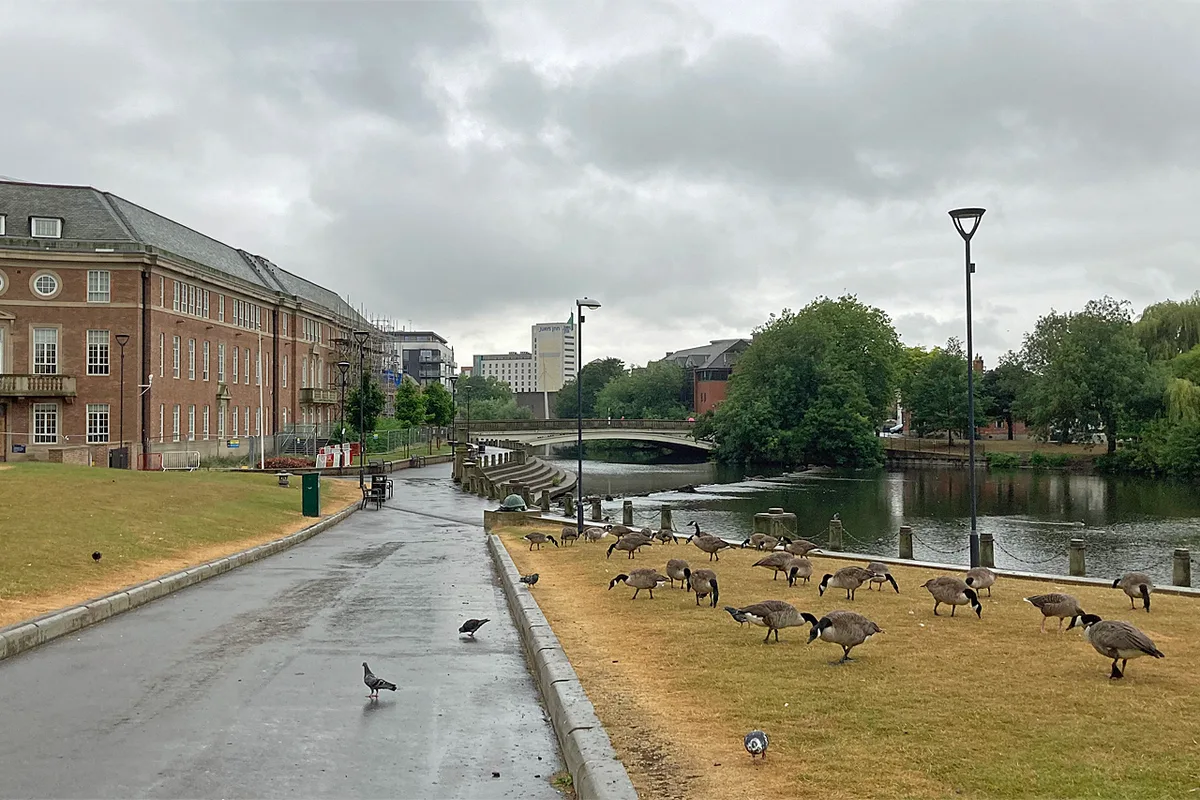
Riverside Garden
Country parks · 0.2 km

Boy and Gander
Heritage railway stations · 0.2 km

Derby QUAD
Theatres · 0.2 km

Korean War Memorial
Memorials & monuments · 0.2 km

Dr. John Hollis Pigot 1757-1794
Memorials & monuments · 0.3 km

John Lombe; George Sorocold
Memorials & monuments · 0.3 km
Nearby
📷 3Memorials & monuments · East Midlands
Herbert Spencer Philosopher Memorial
Herbert Spencer Philosopher Memorial — a memorial in england-east-midlands, United Kingdom.
📷 3Memorials & monuments · East Midlands
William Hutton Historian Memorial
William Hutton Historian Memorial — a memorial in england-east-midlands, United Kingdom.
📷 5Historic bridges · East Midlands
Exeter Bridge
Exeter Bridge is a historic bridge in the United Kingdom.
📷 3Memorials & monuments · East Midlands
Exeter Bridge Rebuilt 1929-31
Exeter Bridge Rebuilt 1929-31 — a memorial in england-east-midlands, United Kingdom.
📷 5Public art & sculpture · East Midlands
Turtle
Turtle — a public art in england-east-midlands, United Kingdom.
📷 5Open-air theatres · East Midlands
Assembly Rooms
Assembly Rooms — a open-air theatre in england east midlands.
Where to eat & stay near Exeter House
Places to stay
 📷 7
📷 7Hotels · East Midlands
Georgian House Hotel
Georgian House Hotel — a hotel in england east midlands.
 📷 5
📷 5Campsites · East Midlands
The Orchard Campsite
The Orchard Campsite — a campsite in england east midlands.
 📷 5
📷 5 📷 5📷 5📷 5
Places to eat & drink
 📷 3
📷 3Historic pubs · East Midlands
Jorrocks
Jorrocks — Historic pub — listed building or notable heritage status.
 📷 5
📷 5Historic pubs · East Midlands
Ye Olde Dolphin Inne
Ye Olde Dolphin Inne in England East Midlands, United Kingdom.
 📷 5
📷 5Historic pubs · East Midlands
Wardwick Tavern Public House
Wardwick Tavern Public House in England East Midlands, United Kingdom.
 📷 7
📷 7Historic pubs · East Midlands
Brunswick Tavern
Brunswick Tavern in England East Midlands, United Kingdom.
 📷 7
📷 7Historic pubs · East Midlands
Ye Olde Spa Inn Public House
Ye Olde Spa Inn Public House in England East Midlands, United Kingdom.
 📷 7
📷 7Historic pubs · East Midlands
The William IV Public House
The William IV Public House in England East Midlands, United Kingdom.
More historic houses in this region
.jpg?width=1200) 📷 5
📷 5Historic houses · East Midlands
Barn Hill House
Barn Hill House — house in Stamford, South Kesteven, England, UK.
 📷 5
📷 5Historic houses · East Midlands
Bath House
Bath House — house in Stamford, South Kesteven, Lincolnshire, England, UK.
 📷 5
📷 5Historic houses · East Midlands
Bath House Or Banqueting House
Bath House Or Banqueting House — Grade I listed house in Barnack, Peterborough, Cambridgeshire, England, UK.
.jpg?width=1200) 📷 5
📷 5Historic houses · East Midlands
Bursar's House
Bursar's House — house in Stamford, South Kesteven, England, UK.
Frequently asked questions
- Where is Exeter House?
- Exeter House is in the East Midlands, United Kingdom (postcode DE1 2EW), in the parish of Derby, unparished area.
- What is Exeter House?
- Exeter House — house in United Kingdom.
- How do I get to Exeter House?
- The nearest railway station is Derby, about 1.1 km away. The nearest town is Horsley. Drivers can use postcode DE1 2EW.
- Is Exeter House free to visit?
- Yes, Exeter House is free to enter.
- How do I get to Exeter House?
- The nearest railway station is Derby, about 1.1 km away. Drivers can navigate to postcode DE1 2EW.