
Heritage railway stations · South Wales
Celtic Ring
Also known as: Ieithoedd Celtaidd, Teangacha Ceilteacha, Cànanan Ceilteach
In or near Cardiff.
Celtic Ring — Public artwork (sculpture) by Harvey Hood.

Wikimedia Commons contributors — see linked file page for photographer and licence licence

Plan your visit
- Typical visit
- 1 h–2 h
- Nearest railway station
- Cardiff Bay · 0.5 km
- Free entry
Getting there & planning your visit
To visit the Celtic Ring, the nearest railway station is Cardiff Bay, which is 0.5 km away. Entry is free. The postcode for sat-nav is CF10 4PZ.
About
Celtic Ring is a place of interest in South Wales. Built or established in 1993, it dates from the modern period. The site is a Ramsar wetland of international importance. It sits within the Cardiff South and Penarth parliamentary constituency. The nearest railway station is Cardiff Bay, about 0.5 km away. Postcode area CF10.
Photo gallery
Official information
The Glee Club Cardiff is a popular venue for live comedy, hosting a variety of stand-up performances throughout the week. Visitors can enjoy shows featuring both established and emerging comedians in a lively atmosphere.
Protected designations
- Ramsar wetland: Severn Estuary
Designations sourced from Natural England open data under OGL v3.
From the Wikipedia article
The Celtic languages ( KEL-tik) are a branch of the Indo-European language family, descended from the hypothetical Proto-Celtic language. The term "Celtic" was first used to describe this language group by Edward Lhuyd in 1707, following Paul-Yves Pezron, who made the explicit link between the Celts described by classical writers and the Welsh and Breton languages. During the first millennium BC, Celtic languages were spoken across much of Europe and central Anatolia. Today, they are restricted to the northwestern fringe of Europe and a few diaspora communities. There are six living languages: the four continuously living languages Breton, Irish, Scottish Gaelic and Welsh, and the two revived languages Cornish and Manx. All are minority languages in their respective countries, though there are continuing efforts at revitalisation. Welsh is an official language in Wales and Irish is an official language across the island of Ireland and of the European Union. Welsh is the only Celtic language not classified as endangered by UNESCO. The Cornish and Manx languages became extinct in modern times but have been revived. Each now has several hundred second-language speakers. Irish, Manx and Scottish Gaelic form the Goidelic languages, while Welsh, Cornish and Breton are Brittonic. All of these are Insular Celtic languages, since Breton, the only living Celtic language spoken in continental Europe, is descended from the language of settlers from Britain. There are a number of extinct attested Continental Celtic languages: Galatian, Lepontic, Gaulish, Celtiberian and Gallaecian, where the last two form Hispano-Celtic subbranch. Beyond that, there is no agreement on the subdivisions of the Celtic language family. Traditionally, they are considered to be divided into P-Celtic and Q-Celtic. However, Gaulish is considered more closely related to Insular Celtic than either of these two are to Celtiberian; proposed connection between Gaulish and Insular Celtic is called Nuclear Celtic. The Celtic languages have a rich literary tradition. The earliest specimens of written Celtic are Lepontic inscriptions from the 6th century BC in the Alps. Early Continental inscriptions used Italic and Paleohispanic scripts. Between the 4th and 10th centuries, Irish and Pictish were written in original script, Ogham, but Latin script came to be used for all Celtic languages. Welsh has had a continuous literary tradition from the 6th century AD.
Excerpt from Wikipedia under CC BY-SA 4.0. See the source article linked in Sources below.
Background
Description
Although there are many differences between the individual Celtic languages, they do show many family resemblances. Examples:
Sourced from Wikipedia under CC BY-SA 4.0.
- Coordinates
- 51.4631, -3.1642
- District
- Cardiff
- Parish
- Butetown
- Postcode
- CF10 4PZ
- Parliamentary constituency
- Cardiff South and Penarth
- Phone
- +44 871 472 0400
- Established
- 1993
- Nearest railway station
- Cardiff Bay — 0.5 km
Sources
- osm: n7409075715 (ODbL)
- commons: Celtic Ring sculpture, Roald Dahl Plass.jpg (CC BY-SA 4.0)
- wikipedia: Celtic languages (CC BY-SA 4.0)
Other places nearby

Celtic Ring
Public art & sculpture · 0.0 km

Mermaid Quay Commercial Pontoons
Piers · 0.0 km
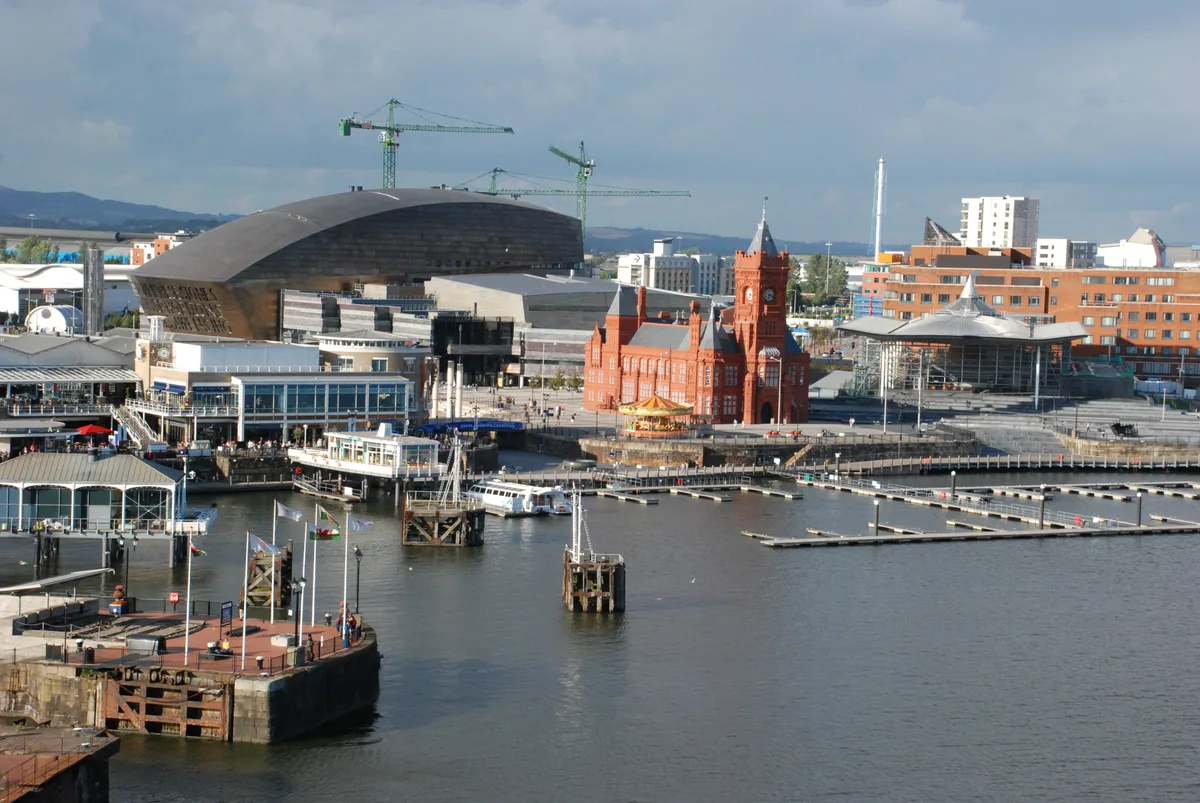
Cardiff Bay
Mountains & hills · 0.0 km

Mermaid Quay Commercial Pontoons
Piers · 0.0 km

Everyman Cinema
Cinemas · 0.0 km

Mermaid Quay Commercial Pontoons
Piers · 0.0 km

Mermaid Quay Pay & Display Pontoons
Piers · 0.1 km

Mermaid Quay Commercial Pontoons
Piers · 0.1 km

Mermaid Quay Pay & Display Pontoons
Piers · 0.1 km

Pierhead Building
Gardens · 0.1 km

Mermaid Quay Pay & Display Pontoons
Piers · 0.1 km
Mermaid Quay Pay & Display Pontoons
Piers · 0.1 km
Nearby
📷 4📷 3Piers · South Wales
Mermaid Quay Commercial Pontoons
Mermaid Quay Commercial Pontoons is a pier in the United Kingdom.
📷 4Mountains & hills · South Wales
Cardiff Bay
Cardiff Bay — bay and area created by the Cardiff Barrage in South Cardiff, Wales.
📷 3Piers · South Wales
Mermaid Quay Commercial Pontoons
Mermaid Quay Commercial Pontoons is a pier in the United Kingdom.
📷 5📷 3Piers · South Wales
Mermaid Quay Commercial Pontoons
Mermaid Quay Commercial Pontoons is a pier in the United Kingdom.
Where to eat & stay near Celtic Ring
Places to stay
 📷 5
📷 5Hotels · South Wales
St. David's Hotel
St. David's Hotel — a hotel in wales south.
 📷 5
📷 5Hostels · South Wales
Cardiff Central Youth Hostel
Cardiff Central Youth Hostel — a hostel in wales south.
 📷 5
📷 5 📷 5
📷 5Hotels · South Wales
Clayton Hotel
Clayton Hotel — a hotel in wales south.
 📷 5
📷 5 📷 5
📷 5Hotels · South Wales
The Royal Hotel
The Royal Hotel — a hotel in wales south.
Places to eat & drink
 📷 3
📷 3Restaurants · South Wales
Duchess of Delhi
Duchess of Delhi — a restaurant in wales south.
 📷 5
📷 5Restaurants · South Wales
Cedar Tree Farm
Cedar Tree Farm — a restaurant in wales south. Cuisine: british. Brand: Farmhouse Inns.
 📷 5
📷 5Historic pubs · South Wales
The Corner House
The Corner House in Wales South, United Kingdom.
 📷 5
📷 5 📷 7
📷 7 📷 5
📷 5Other places from this era
 📷 5
📷 5Heritage railway stations · London
A Bullet from a Shooting Star
A Bullet from a Shooting Star — Public artwork (sculpture) by Alex Chinneck.
 📷 5
📷 5Heritage railway stations · London
A Pear and a Fig
A Pear and a Fig — Public artwork (sculpture) by Ali Grant.
 📷 5
📷 5Heritage railway stations · London
Admiral Lord Nelson
Admiral Lord Nelson — Public artwork (statue).
.jpg?width=1200) 📷 5
📷 5Heritage railway stations · London
Assembly
Assembly — Public artwork (installation) by Peter Burke.
More places in this region
 📷 3
📷 3Heritage railway stations · South Wales
A Private View
A Private View — Public artwork (sculpture).
 📷 3
📷 3Heritage railway stations · South Wales
a two bar relationship
a two bar relationship — Public artwork (sculpture) by Sean Edwards.
 📷 3
📷 3Heritage railway stations · South Wales
Alight
Alight — Public artwork (sculpture) by S Mark Gubb.
 📷 4
📷 4Heritage railway stations · South Wales
All Hands
All Hands — Public artwork (sculpture) by Brian Fell.
Frequently asked questions
- Where is Celtic Ring?
- Celtic Ring is in South Wales, United Kingdom (postcode CF10 4PZ), in the parish of Butetown.
- What is Celtic Ring?
- Celtic Ring — Public artwork (sculpture) by Harvey Hood.
- How do I get to Celtic Ring?
- The nearest railway station is Cardiff Bay, about 0.5 km away. The nearest town is Cardiff. Drivers can use postcode CF10 4PZ.
- When was Celtic Ring built?
- Built or established in 1993.
- Is Celtic Ring a protected site?
- Yes — Celtic Ring is part of the Severn Estuary Ramsar wetland.
- Is Celtic Ring free to visit?
- Yes, Celtic Ring is free to enter.
- How do I get to Celtic Ring?
- The nearest railway station is Cardiff Bay, about 0.5 km away. Drivers can navigate to postcode CF10 4PZ.